

Comics News
Tripwire Talks To Veteran 2000AD Artist Ian Gibson

A Life Lived In Comics
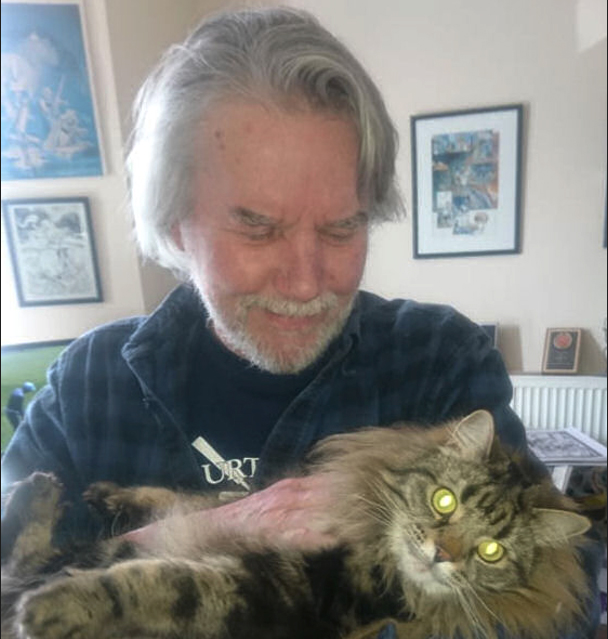
Tripwire’s contributing writer Paul N Neal just spoke to veteran artist Ian Gibson (Halo Jones, Star Wars) about his long career in comics…
Paul: What was the first comic you first recall reading and enjoying?
Ian: That’s a complicated question. I may have to break it down into parts. My first comics were the Lion and Tiger which seemed to feature a lot of war stories and football. Neither of which impressed me. On the rare occasion my parents would splash out on the Eagle, which was much more interesting as it had cowboy stories and spacemen. And I could listen to the adventures of Dan Dare on my tiny radio. It never occurred to me that people made a living out of drawing comics, so eventually, to my parents’ disappointment, I went to art college to do a fine arts degree. But I soon learned that the whole shit show is as phoney as can be. So I went away to study, for myself, Pre-Columbian culture and art. That’s where I learned the power of black outlines by discovering fragments of Peruvian pottery in the museum that was opposite the art college. A while later when I was sharing a flat with a chap doing library studies, I saw his comic collection and was introduced to the wonders of Jack Kirby’s Thor. From then on I started drawing my own stories and presented a book of them at my final show. (Well, you did ask!) 😉
Paul: Was this your final show at college?
Ian: Yup. My degree show. But that’s another very complicated story involving what became Proximan Script.
Paul: In which case, because inquiring minds want to know, can talk about Proximan?
Ian: That was the script I used for all the strange signs in the Halo story when she was on the Hoop. Some were Swedish, some were Spanish, but the majority were in what became known as Proximan script. It was a script that I designed in my last year of college. It was the time of revolution when we were taking over the campus buildings back in 1968/9. I had designed the script as an alternative to our regular alphabet as I though it needed improving (probably because my own handwriting was shite!) and I wrote a letter using it to the International Times, which was the underground paper of the day. And they published it on the inside front page with the comment: ‘What’s this?’ Some smart kid from some special school deciphered the code and wrote to me in it. So, encouraged by this I decided, as part of the revolutionary stance, to write my final paper in it, along with cartoon illustrations of famous artists like Michelangelo and Rembrandt. The decision of those who officiate such things was that I was a genius, but they couldn’t give me an honours degree as they couldn’t understand it!
Paul: It is the curse of being a genius, isn’t it? They’re often ahead of the times and underappreciated. On the subject of genius, how did Halo Jones first originate? Did you have much story input into it?
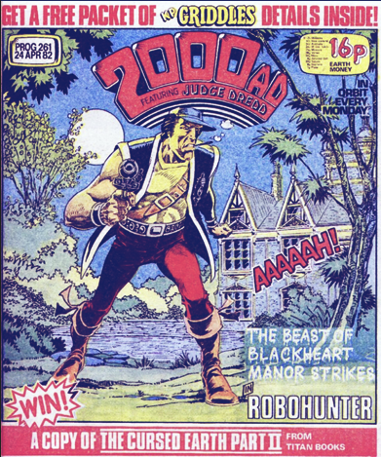
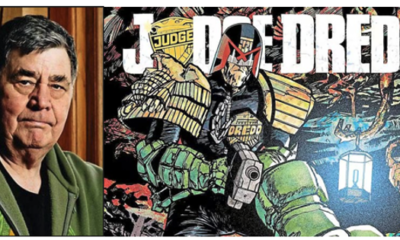
Ian: After a signing session at Forbidden Planet, Steve MacManus came up to me and said: “You’ve just done a long stint on Dredd and an even longer stint on Robohunter. Is there anything you’d like to do next?” Previously I’d asked Steve if 2000AD could serialise Bobby Heinlein’s Friday, as they’d done with Harry Harrison’s Steel Rat, but they had said no. Maybe the Heinlein society didn’t approve? But as I’d seen Jim Baikie’s Skizz written by Alan Moore, I figured it might work if Alan was into writing stories with girls in the lead.
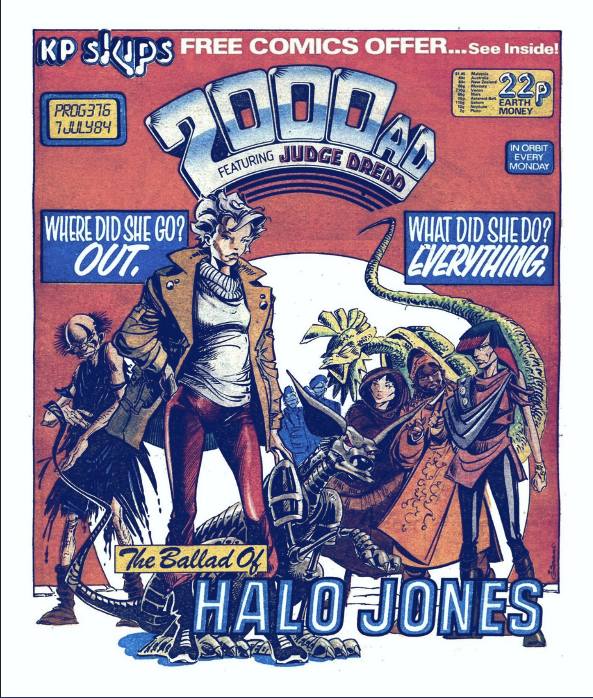
I must confess that I’d been more attracted to the story by Jim’s art, and I don’t think I actually read much of it. It had always annoyed me that stories which featured women somewhere in the cast either had them screaming or fainting etc and their dialogue was in no way feminine. I considered them to be ‘men with tits’!! I wanted to make a change. I told Steve: “I want to work with Alan on a girl’s story.” So, he introduced me to the hairy one and I told Alan: “I want a story without thought bubbles or explanatory captions, as I never see signposts proclaiming ‘Little did he know’ or shit like that. I wanted the story to be experienced by the reader the way we go through our daily lives – we figure it out as we go. Alan said fine and he went away, coming back six months later saying: ‘We have a winner! Girls, Rockets and Monsters!” Sadly, I had to put him right on a few things, but I’m sure you’ll ask what those were.
Paul: Ian, you dangled a carrot there. What were the things you managed to correct Alan Moore on?
Ian: His first plotline had Halo out in space on some asteroid discovering a mysterious ship. I asked him what her motivation was, and he said “Escape”. So, I said “Well then, we have to show what she’s escaping from, and the best way to show what a world is like is to go shopping in it. If Tesco has been firebombed, Sainsburys has a hostage situation etc, then you have to plan your shopping expedition like a military campaign.” Then he suggested the story was set on a floating island called the hoop which was powered by Manhattan. I said, “Don’t be silly. If this is an island out in the ocean it would be used as a wave/energy producer that supplies Manhattan. Not the other way around.” I sent him sketches of how the Hoop would look and the fact that it would need to open to allow mega waves to pass through without it busting apart, which he managed to incorporate into the story. It was just simple stuff like that. 😉
Paul: Would it be fair to say your career has been marked by working mostly with the incredible John Wagner and Alan Moore? I’m told their scripts vary in detail and style a lot. Is that true and can you compare them at all? As an artist, which of the two approaches do you find more rewarding?
Ian: My preference has always been John. He’s a great writer with a wonderful sense of humour. He doesn’t waste pages of picture descriptions that he knows I’m going to ignore, whereas Alan runs off at the typewriter.

John wrote Robohunter especially for me, after he’d seen the cute robots I drew in the Call me Kenneth series. Despite the editorial team giving the first few episodes to Jose [Ferrer] and having to phone me up to say: “Whoops. Can you fix it?” John loved to give me silly stories. One day he called me up to ask about the town I lived in. My answer was that a friend described it as “A graveyard with traffic lights”. John said “Excellent” and wrote the Dredd story of Death in Bexhill, with lines like “Drop that crock, Death!”. And another time he called to ask where we should locate the Olympics. My suggestion was we should concrete over a beautiful attol or despoil some beautiful part of the world. We ended up with the Everest Hilton in Return of the Taxidermist. But possibly my favourite thing he wrote was: “One of your crowd scenes”, which makes a world of difference to just “Crowd scene”
Paul: You’ve worked a little for American publishers. I fondly remember enjoying Steed and Mrs Peel issues. Did you find that a very different experience?
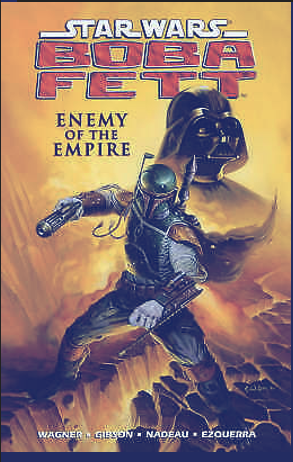
Ian: I’ve worked with several US publishers from First Comics where I did a short run series called Meta4. I worked with John Ostrander on StarJammers for Marvel and I worked quite a bit with Dark Horse comics on their Star Wars Droids series, where Ryder Windham wrote Droids Rebellion specifically for me. Plus, I worked on their Boba Fett series till I got fed up with that dreadfully designed Darth Vader.
Oh, and I did an episode of HitchHikers Guide for one of DC’s affiliate houses, but it never saw the light of day as I called the editorial team a bunch of wankers and quit. I also did a series of Mr Miracle for DC, but I hated the corny scripts which I thought were an insult to the memory of King Jack [Kirby]. I was constantly changing the scripts and erasing speech bubbles that I thought were a waste of space. So eventually they lost patience with me.
Paul: Wow. I get the impression 2000AD is really your spiritual home. How does it feel being a 2000AD legend? Do you enjoy conventions? Have they changed a great deal over the years you’ve been in the comic industry?
Ian: I wouldn’t say 2000AD was a spiritual home, especially since the run-ins with various editors there, but it was a good place to make a living and develop my limited skills as I went along. I used to have fun at conventions, interacting with the fans and trying my best to give back in the way of sketching for them. Cons are different all over the world, from the few I have attended. The Liburnicon in Croatia was lots of fun. So was the Norcon in the States, where I took my nine-year-old son and he introduced me to one of my heroes, Al Williamson!
Cons are always nice places to meet and greet fellow artists and creators, but since I developed my wrist problems I have been avoiding cons, apart from the Bristol one called Lawgiver. There the fans were very patient with my attempts at sketching for them.
Paul: In recent years, digital comic have become popular. You’ve seen some changes in the comic industry during your career. Do you see them as a positive or a negative development?
Ian: If I said digital stuff is shite but it doesn’t smell quite so bad, would that answer the question?
Paul: Would you be able to provide a slightly more elaborate answer to better explain your feelings?
Ian: I’m not sure what I hate most. But the ‘undo’ function has to be high on my list.
Paul: I had a sneaky feeling this might be a topic you might be outspoken about.
Ian: I confess to coming at this subject with sparse information, as I have avoided digital functions other than scanning in finished pieces of art. One thing that disappoints me is the ability to take readymade figures and objects and complete scenery and mould it through fancy functions to fit whatever scene is being worked on. The chap who asked me to do Annie Droid for the Times used something called poser for his own advertising work. And I’m sure there are much more sophisticated programs now, as that was back in the days of the Millennium Bug, which is what I wrote the Annie Droid story about.

Happily, I got Annie to destroy the Bug and we all survived the ‘crisis.’ It also reminds me of the time I spent working with Blas Gallego on stories like Sugar Jones. He was quite happy to trace directly from figures in Vampirella stories just by holding the magazine up to the window along with his paper. And when I questioned this behaviour his response was ‘Fuster’, which was the name of a friend who used to mutter “This is for the toilet!” while working on girls magazines. I guess a lot depends on how much self-respect you have in your work and how much respect you have for the publisher and the reader.
Paul: So, is it fair to say you have yet to be convinced of the merits of digital comics, or your fans reading enjoying your fabulous work on a tablet or a computer etc?
Ian: You just have to look at the digital mess that was made of Halo Jones in colour and some of the horrendous colouring of my black and white series like Banzai Battalion to get a good guess as to my answer.
Paul: Are there any opportunities in the comic industry you turned down that looking back on them that you regret not going ahead with?
Ian: I thought it was a shame that the editors of the Hitchhiker series were such assholes, as I’d love to have done that as homage to a great writer.
Paul: Can you expand upon that at all? I love the books.
Ian: When I was in the States visiting DC in New York, and they were kind enough to book me into the Chelsea Hotel, I was asked to get on board with the Hitchhiker series, probably because it featured cricket and they couldn’t find an American artist who knew anything about it. I had a lot of fun drawing some 50 or so pages with wonderful characters like the cricket commentators we all knew and loved, like Richie Benaud and Blowers tucking into their cake. It wasn’t till I’d done all the pages of pencils that they decided to tell me that they didn’t have permission to use likenesses of the TV characters. I was not impressed!
Plus, I had gone to some lengths with the help of my apprentice to make sure the script adhered to the book and then found to my dismay that the dumb writer was allocating dialogue to the wrong characters, like Marvin’s charming interlude with the mattresses in the swamp. I guess that should have alerted me to what complete tosspots they were. So eventually I told them to stuff it and walked away with no kind of compensation for my time.
Paul: Given your years or work, where do you see the future of the comic industry going? With 200AD specifically in mind what do you hope for the future?
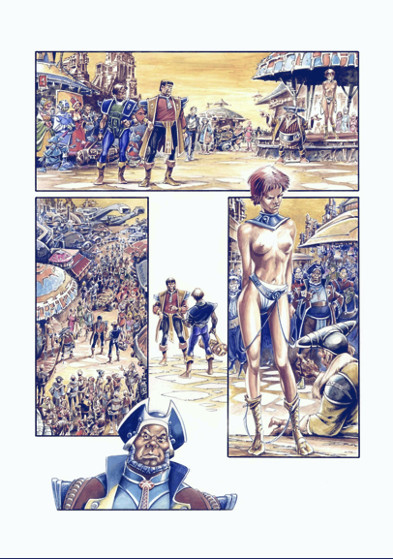
Ian: In this country Rebellion, who bought 2000AD for pennies but refused to give the rights back to the creators as had been stipulated in the contract, only bought the company with the intent of making a profit from games based on the characters. As a result they have no real interest in producing quality. Hence the shitshow that is now 2000AD. Happily they have stopped sending me copies. The future of comics is in the hands of any independents who can muster up enough cash to get their stuff printed, as I myself intend to do with my Lifeboat saga, with the intent to donate a chunk of any profits to the fekkin heroes who go out in all weather to save idiots and unfortunates by equal measure. My health has stalled the process, but I live in hope. Here’s one of my favourite pages.
Right now, it’s a mess. You get DC editors going off to a retreat to dream up stupid shit like the Millenniumseries, which was purely an attempt to capture an audience over the summer break, when kids went home and were no longer near the same paper shops to get their fix of weirdos in spandex suits. So, they made the whole shemozzle into a cross over where you had to buy this comic to find out what your regular hero was up to. That is possibly the worst-ever reason to write a ‘story’ dreamed up by man!








You must be logged in to post a comment Login