

Comics News
Tripwire Talks To UK Indie Writer Laurence Alison About Working On Odysseus, Circe And More

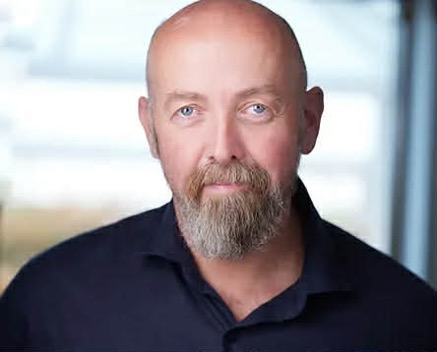
Reinterpreting The Classic Tales For The Four-color Medium
Tripwire’s contributing writer Paul N Neal endeavours to keep an eye out for exciting developments in the UK Comic Industry. One of the more fascinating new voices within that industry is writer Laurence Alison.
The Kickstarter campaign for Volume Four of the writer’s adaptation of The Odyssey, or more specifically Odysseus, is online now. So, it felt like it was time Tripwire asked the gentleman a few questions about his writing and his plans for the future.
For those that wish to support the project here is the appropriate link:
https://www.kickstarter.com/projects/bhuna/odysseus-in-defiance-of-the-gods-book-four…
***
TRIPWIRE: Much of your recent writing is steeped in classic Greek literature. For the casual reader, these myths and stories are perhaps best remembered in the form of movies enjoyed on a Sunday afternoon featuring the incredible special effects of Ray Harryhausen. Do these classic legends mean a great deal more to you than that? Would you describe yourself as something of a scholar on the subject?
LAURENCE: Certainly, the Ray Harryhausen films were hugely significant to me. I loved all of them. I was keen on the Sinbad ones and of course, Jason & the Argonauts. I had a big poster of the cyclops in my bedroom. However, with all my stories, I have a habit of going into the research. In that regard, and specifically for Odysseus. I must have listened to at least 9 or 10 versions of the Odyssey on Audible. In addition, and for Heracles and various other myths, I’ve done quite extensive reading. But I wouldn’t describe myself as a scholar.
LAURENCE: Also, I’m not at all interested in simply repeating the stories, or at not least repeating them in a way that is predictable and well established. The Greeks were principally orators anyway, and stories changed with the telling and retelling over time. It’s very important for me to make the stories contemporary and mix it up a bit.
For example, in Circe, Simon Harrison and I have very deliberately made the key character, who is of course female, much stronger and more powerful than is normally the case. As you may well know, in ancient Greece women were very badly treated. And we wanted to reverse those roles in Circe.
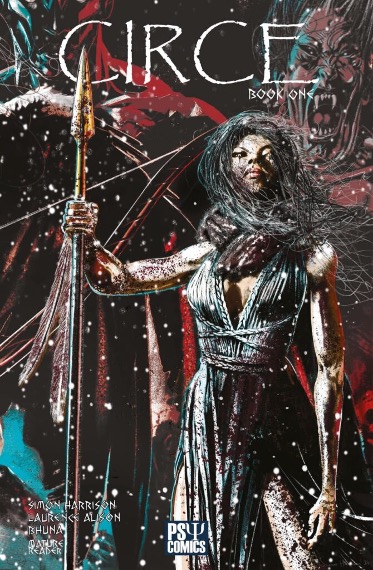
TRIPWIRE NOTE: Arist: Simon Harrison.
TRIPWIRE: Outside of writing comics, I understand your professional career has been pretty eventful and unique. You are very accomplished and respected for your numerous accomplishments. To what extent has your “Day Job” informed your comics writing?
LAURENCE: I think it’s impossible for your life and experiences and indeed one’s work to not enter in some way into the way that you create and write.
Perhaps, in my job, which can be very intense where I work at the extreme edges of society, there is a tendency for me to drop in certain elements that I have learnt or experienced in the last 30 years. Specifically, this might relate to some of the villains in the work that I create, but as well as that, some of the heroes. What I do as a job can be very depressing and dark at times, but one should always be mindful of the fact that I’ve also been impressed by the heroism of humanity.
TRIPWIRE: Can you briefly describe what we have referred to as your “day job.” Many readers are unaware what you have done and what I understand you continue to do.
LAURENCE: I’m a forensic and investigative psychologist. So, I research crime and criminality.
TRIPWIRE: Is there a chance you could expand upon that?
LAURENCE: I do research to assist law enforcement catch the bad guys.
TRIPWIRE: Are you Robbie Coltrane’s character from the ITV series Cracker in real life? Or is that a slightly ignorant reference?
LAURENCE: Yes but I use science, not bullshit 😊
TRIPWIRE: Do you think there are any particular themes or archetypal characters that are typical to your writing?
LAURENCE: This is an interesting question and it’s weird how, having now written several stories, I have started to identify themes that keep emerging. These are obviously working at an unconscious or subconscious level because I don’t intentionally put all of them in, and some of them have been a surprise even to me.
That said, my constant theme of attacking authority figures or people that are in power but that don’t deserve to be where they are is conscious to me. That seems to be a consistent theme that I am fully aware of. However, it has surprised me how often I seem to write heroic women rather than heroic men. And how often in fact many of my male characters are very flawed. That’s a revealing insight!
LAURENCE: In addition, I play a lot with the idea of what makes something masculine or feminine, and whether these attributes are positive or negative or perhaps both. This appeared in my early writings and even in Heracles, as well as the Argonauts, Circe, and indeed Odysseus. I’m also interested in the idea of transformation, change, redemption and how characters who are deeply flawed can improve themselves.
TRIPWIRE: To what extent do you find creating comics a collaborative process? Do you alter your approach to a story depending on a given artist’s strengths and weaknesses.
LAURENCE: In short, yes! A substantial joy of comic book writing is that what emerges is a product of the two people, or indeed the three people that are involved. This includes the letterer and design work of course as well. I’ve gone out of my way to select artists that are very different. This creates a melting pot of ideas and it certainly is the case that I will write something for artists and very much bear them in mind in the creative process.
One of the things that I especially enjoy about comic books is that it is genuinely is a marriage of writer’s ideas with the artist’s vision and often I will change some elements of a story or at least the feel or vibe or atmosphere of a story depending on the artist with whom I am working.
I can’t think of a more intimate collaborative process than comic books, other than perhaps playing in a band. I would like to think one of my strengths is being very respectful of what the artist does and recognising that it certainly is much more arduous and demanding than the writing part. That is why I am eager to please them, keep them happy and make sure that they have things that they like to draw rather than harassing them with a bunch of irritating images that they will find boring or laborious.
TRIPWIRE: When you have a project planned, what is it you look for in an artist? I noticed online you may be seeking an artist for an Aphrodite script for example. At such an embryonic stage, what makes one artist stand out from another?
LAURENCE: I’m always looking for something different, something unique and not run-of-the-mill. I’ve had several artists approach me that are very competent, professional comic book artists. All of them draw very well, can tell a story and can-do figure work. But that’s not enough for me.
I would almost prefer someone that has a naive style or doesn’t necessarily manage anatomy or landscapes or whatever particularly well, but that their style is utterly unique. If you look at the range of artists that are working with us now, they are extremely diverse. I think that diversity is a strength of what we do in PSYComics.
It’s a bit like the early days of 2000 AD where you had people that were as different as Brian Bolland, Mick McMahon, Brett Ewins, Steve Dillon and many others. One of my favourite artists of all time was Massimo Belardinelli, and he certainly hadn’t mastered anatomy particularly well, but he was utterly unique. No one else drew like him and his vision was extremely rare.
TRIPWIRE: The Odyssey is by definition an epic story to adapt. It may be the definitive “Epic.” How did you approach the story of Odysseus? Have modern sensibilities played into your thoughts as you produce this adaptation? I ask because it is a story that has been poured over and dissected by so many, what made you feel confident you had something new and fresh to add to such an iconic text?
LAURENCE: At first I was intimidated writing the Odyssey, but as I read and listened to more and more versions there were certain things that I didn’t like about different versions. For example, Stephen Fry’s account of it made Odysseus a very bland character in my opinion. And yet Odysseus is obviously psychopathic, very smart, very manipulative, very hubristic in many ways but also deeply traumatised.
It’s very clear that he never wanted to enter the war in the 1st place and was tricked into it. Therefore, he’s a complicated character. In fact, in the Emily Wilson translation, I think her translation of Odysseus is that he is complex. This makes for an interesting character. And the character drives the narrative. I didn’t really worry about whether I was producing anything different because as you work through the story, you bring your own mindset and experiences to it.
Like I answered in the previous question, part of you emerges in the story whether you like it or not, and that is part of what makes it different. I’d like to think that my Odysseus story is gritty, brutal in parts, but also complex with a variety of different characters, villains, heroes and complicated individuals.
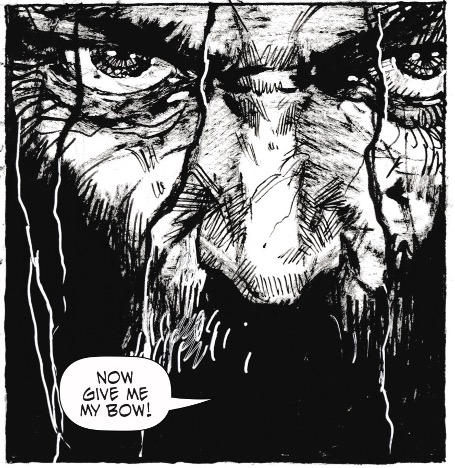
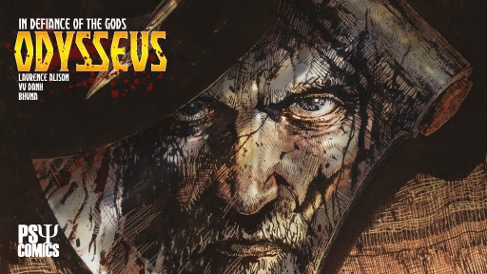
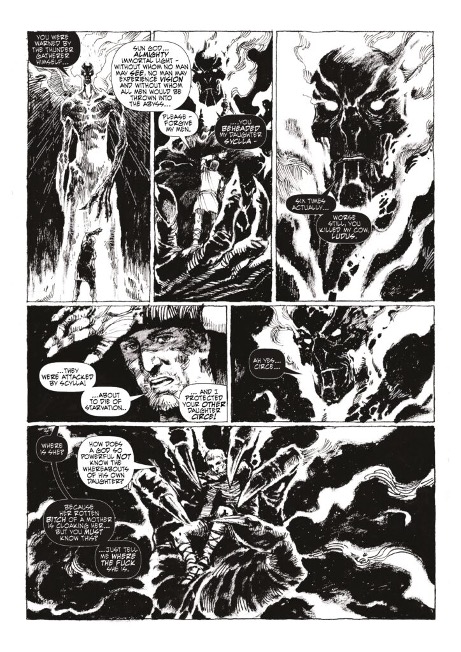
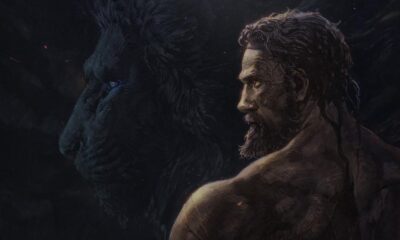
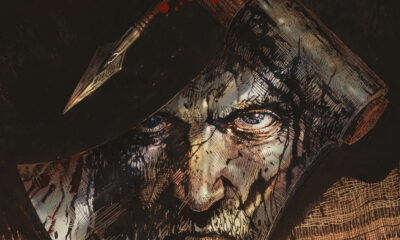
TRIPWIRE NOTE: The Artist here is Vu Danh, as is the following image.
LAURENCE: The joy of it is that the Odyssey isn’t the final account of Odysseus’ life, and there is 2 lines of another poem that still exist (The Telogony) but don’t tell the final fate of Odysseus since the rest of the poem no longer exists.
Fortunately, I am working again with Simon Harrison, a wonderful artist who will be working on an 80-page version of our final story of how Odysseus meets his demise. I’ve been working up to this for a while with other stories bubbling along the background, including Medusa and the Argonauts.
These stories will intersect at one point and bring us to the final Odyssey, where I will then have to start thinking about other things to write about other than Greek myths and legends. Certainly, King Arthur Pendragon is one that appeals to me, living in North Wales and knowing quite a bit about that story and feeling that I could definitely do something different with that particular mythology.
TRIPWIRE: Beyond Aphrodite, what are you working on right now and what can readers expect from you in 2026?
LAURENCE: PSYComics Is going to be very busy this year. We have an absolute ton of stuff coming out. Let me see if I can list it all.
First, we will have the trade paperback of Odysseus. Then we will have issue 2 of Circe and an oversized version of Circe with wonderful artwork by Simon Harrison. Then we will have the Argonauts with Stuart Kenneth Moore. And following that, Medusa by Vu Danh.
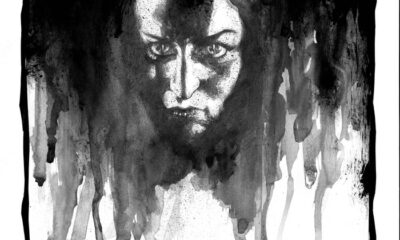
I’m also writing a detective story now that will go under Scratch Comics which is called Heartwood. Set in deepest North America, we’ll have a folk horror vibe as well as a First Nations detective noir. It’s an exciting story and will be illustrated by Warwick Fraser-Coombe, who is doing a wonderful job right now rendering our key characters.
On top of that, I’m working on more Hercules projects, I’m starting to write PenDragon, and I also have a very weird kids’ comic book out with Pebble Tay called Oak and Ash and Thorn. We are going to be very busy this year producing some beautiful comic books.
TRIPWIRE: As a writer of comics, people may be interested in your own comic reading habits. Are there any current creators or titles you make an effort to follow? Alternatively, are there any classic comics that you draw any inspiration from?
LAURENCE: To be honest, there is nothing really that I’m reading at present. I wish I could get back into 2000 AD, but it just doesn’t really do it for me very much anymore. And I’m if I’m being honest, some of the stories I can’t even really understand.
I was a big fan of Marvel and DC and all the British comics many years ago, and then I got into more independent stuff, as well as the more edgy, slightly weird stuff such as Jimmy Corrigan, Dan Clowes work, Chester Gould and many others. I’ve got a wide range of tastes, and as you know, comic books can do anything from romance to erotica to horror to action and adventure to superheroes or whatever. There’s such scope to do so many different stories.
Of course, I have a pretty extensive comic book knowledge, and I like a lot of variety. It’s hard to pick any single thing out. That said, if I had to pick a top three, I almost certainly would go for V for Vendetta. Even now, it still has something to say, perhaps more than ever.
I’m also a big fan of Jimmy Corrigan, The Smartest Man on Earth by the brilliant Chris Ware and finally anything by Pat Mills. Beyond that, there’s a ton of other stuff that I could cite, probably too numerous to mention.
TRIPWIRE: For many writers attending comic conventions is a part of the job. Have you attended many as a guest? If so, are they experiences you have enjoyed? Do you have any favourite conventions?
LAURENCE: I have never been invited as a guest anywhere, and I’m not likely to, I wouldn’t think. I’m not famous in the comic book world at all, and in fact I normally struggle to get a table at a convention even when I apply.
To be honest, that doesn’t really bother me too much and I’m not worried about being popular or famous in that way at all. That said, it’s very nice when someone reads a book that you’ve written and they really get it. We’ve had some terrific reviews across all our work, and it always surprises me and delights me when people are very moved by what you’ve written.
My heart and soul really go into this stuff. And I work hard to make a story both compelling and entertaining to the reader as well as meaningful to myself. My favourite con is Thought Bubble. I’ll be there next year I hope – with a table or without!
TRIPWIRE: If hypothetically Marvel of DC Comics noticed your writing, are there any established comic characters you would genuinely enjoy writing?
LAURENCE: I think I’d got with Wolverine. To me in recent years he’s become a bit too glam.
TRIPWIRE: Can you please say why? How would you write Wolverine?
LAURENCE: To be honest, it’s not a big drive. I’d rather do my own stuff, but I loved him as a kid. [John] Byrne made him a hairy little weird guy! Now he’s too glam.
TRIPWIRE: How do you define “Glam”
LAURENCE: Glossy. Like a model. When Byrne did him he was a short-arsed hairy angry little fucker. Much more interesting.
TRIPWIRE: Finally, as a writer, in your mind, you must have spent some time in the worlds of the wonderful myths and legends you have adapted. Have you ever wondered how you might have fared in that world and in that era? What do you imagine your role could have been? Perhaps even then as a writer?
LAURENCE: Gosh, I can’t imagine I would be a writer in that world. I think I’d be too immersed in the day-to-day business of trying to make a difference directly rather than merely capture it in the written form. Even in my academic career, I’ve dedicated myself to having an impact and making a direct change on the world.
TRIPWIRE: Could Tripwire share any exclusive images or pages from anything your fans might expect to see later this year?
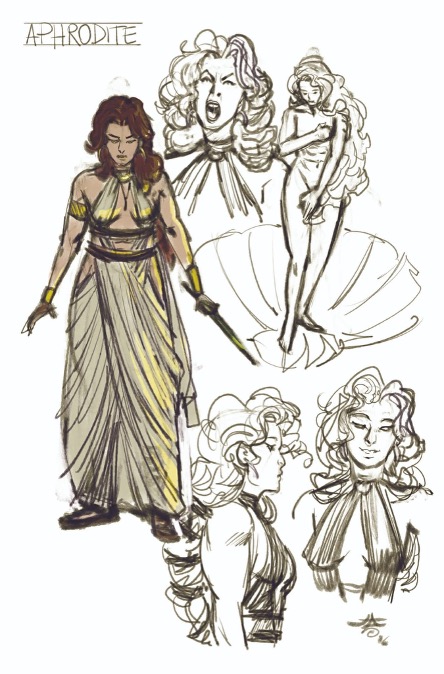
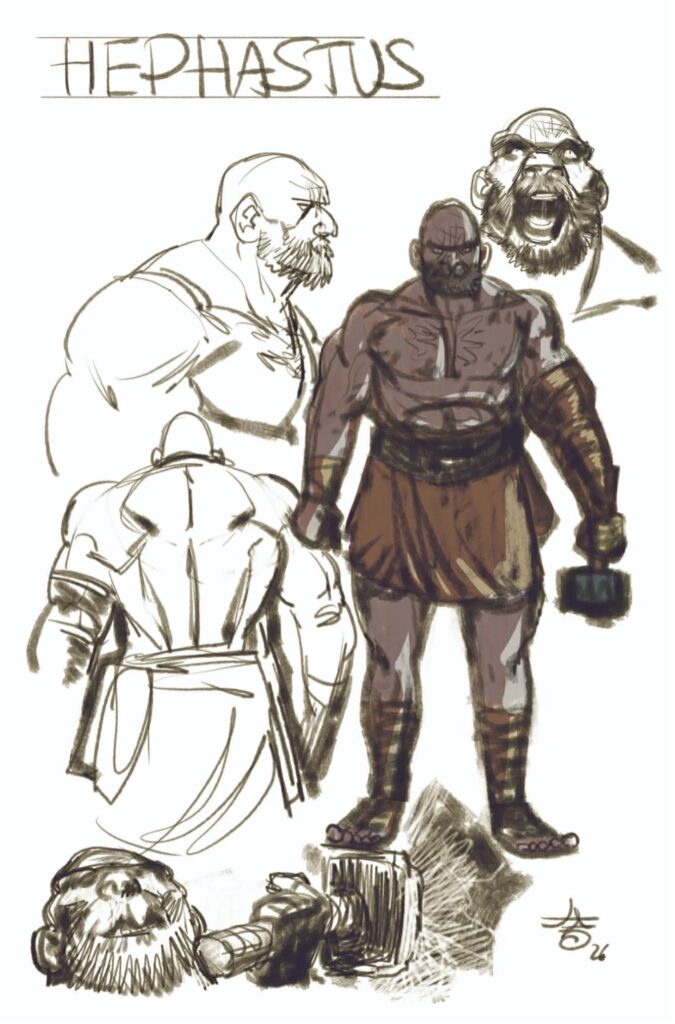
LAURENCE: Yes, one of the later things that I’ll be working on well into the year is Aphrodite. I’ve been fortunate enough to find Francesco Iaquinta who I’ll be working with on that, but it will likely be a short strip. I can share some of the images of the key characters here that no one else will have seen as yet.









You must be logged in to post a comment.