

Comics News
Tripwire Interviews Denton J Tipton About Magma’s Chasing The Dragon


It’s In The Blood
Magma’s Chasing The Dragon by Denton J Tipton and Menton 3 ends this week and Tripwire’s editor-in-chief Joel Meadows spoke to Tipton about the conclusion to the series…
TRIPWIRE: What was the genesis Of Chasing The Dragon?
DENTON J TIPTON: Like how many stories begin, I was compelled to say something about the world around me. And what I was seeing was ugly.
Thanks to the greed of pharmaceutical companies, America had quietly become addicted to prescription opioid pain relievers.
It wasn’t a highly publicised epidemic like crack or meth, instead it lurked in the medicine cabinet of almost every home. I lost a cousin to an overdose. Family and old freinds had become dealers, convicts, and worse.
Menton had similiar experiences, I learned while working with him on comics like The X-Files. He expressed interest in creating a comic with me, and one of our common interests turned out to be alchemy. We both have a love for fantasy novels, so we had a genre.
Since alchemy and chemistry are closely related, cooking up meth or heroin wouldn’t be too far removed from a fantasy setting.
But what could the drug be made of that’s unique to the setting? Why not just go with its biggest metaphor for evil, the dragon?
And after about five years, it took a pandemic to slow things down enough for us to actually chase it down.

TW: Give us the one line elevator pitch for the series
DJT: Two slaves—an alchemist and a concubine—must overcome the burdens of a great secret that could completely transform their world.
TW: What were the biggest influences on Chasing The Dragon for you as its writer?
DJT: I read (and re-read) several books on alchemy, but the ones I would go back to time and again were The Corpus Hermeticum and The Forge and the Crucible. Narratively, the work of Joseph Campbell, Irvine Welsh, Grant Morrison and William S. Burroughs. Although, the alchemy books had as much influence on the story structure as Campbell if you look closely enough. Also, looking back on this list, I didn’t realize how Scottish it was!
TW: Why was Magma the perfect place to publish it apart from the fact that you are its publisher?
DJT: Ha! Being publisher of Magma Comix makes it the worst place! I very much wanted to avoid the stench of a vanity press, so Dragon wasn’t slated for the first wave of titles. But when we couldn’t get one of the other contracts done in time for the announcement of the launch titles, I had to push Dragon forward.
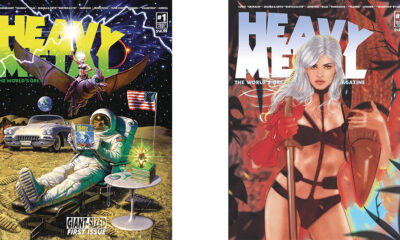
In the beginning, I was pitching it to Heavy Metal before there even was a Magma Comix. And knowing the importance of pitching projects that fit a publisher’s brand, Dragon‘s art, tone and subject matter were squarely in their wheelhouse.
And that pitch actually led to Magma’s inception.

TW: And on a connected question, what do you think that Heavy Metal, which Magma is part of, still offers for creators?
DT: Creative freedom. Metal Hurlant was begun as a creative outlet for art that pushes the envelope, and we’re doing our best to continue in that spirit. I’ve been given carte blanche to publish what I want at Magma, and I extend that freedom to the creators.
TW: How critical are you of your own writing especially work that comes out from a publisher or imprint you are so closely affiliated with?
DJT: Honestly, I don’t really think about that. If I did, I’d be too hard on myself and never write anything. But I have things I’d like to share, and I’ll leave it up to the audience to let me know whether I’m on to something.

TW: How closely did you work with Menton 3?
DT: Too closely! No, he’s in Atlanta while I’m in San Diego, but we had weekly calls throughout the project, and often would talk a few times in between. We’d discuss the subject matter, the characters, and things that he would like to paint, which would always lead to some great ideas for the story. It was very organic that way.
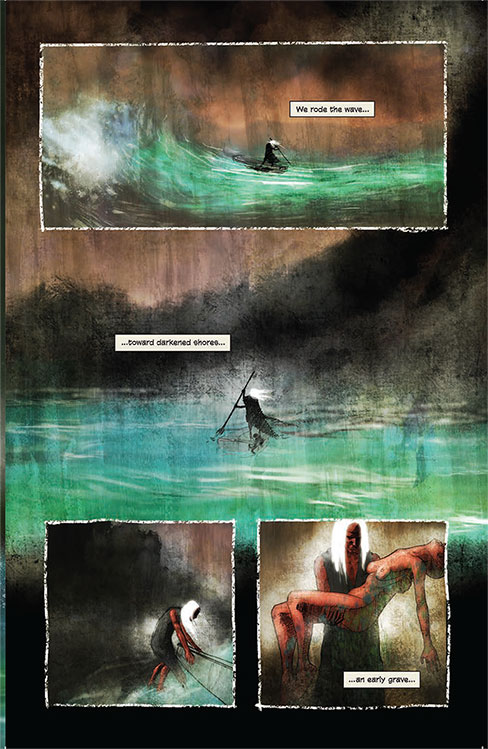
TW: Obviously Chasing The Dragon alludes to drug addiction in our world. Why is it that fictional genres like sci fi and fantasy are able to tackle real-world issues through the prism of an outlandish tale?
DJT: Stories give people the freedom to fail. Failures belong to the characters and their worlds, not the audience’s. There’s distance, but the audience can still relate and sympathize. It’s a safe and quick way to grow.
TW: Now it has ended, with the fifth chapter coming out this week, how do you feel?
DJT: A huge sense of relief.
Making a comic isn’t easy, and with fewer resources than I’m used to, I encountered many new challenges. I was much more involved in every aspect of the entire imprint—contracts, payments, marketing, sales, distribution, just to name a few.
It wasn’t easy to find time to write while setting up a publishing imprint. As I mentioned earlier, that wasn’t part of the plan. But you know about Mike Tyson says about plans, everybody has one until they get punched in the mouth.
But I’d also tack on, “it’s all about how you respond.”

TW: Are there any plans for further adventures with any of the characters in any future comic series?
DJT: By the end of the story, all the characters’ lives have been irrevocably changed, so it would be interesting to explore what comes next, and the big questions that goes with that. Menton really wants to do more, as well.
I guess the big question is whether readers want it. Let me know!

Chasing The Dragon#5 s out this Wednesday 4 August from Magma/ Heavy Metal










You must be logged in to post a comment Login