

Headlines
Spotlight on Beowulf

Mythic Story Brought to Life
♦ From our friends at UK trade TV and Film news website theknowledgeonline.com, we have a feature on ITV’s forthcoming Beowulf series.
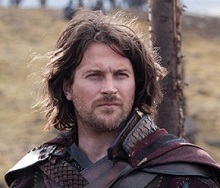
PICTURED: Kieran Bew as Beowulf.
© ITV.
ITV has always been known for its big-budget dramas. But in the last few years it has demonstrated a renewed energy and dynamism, backing shows that appeal to both domestic and international audiences.
Even by its own standards, however, Beowulf: Return To The Shieldlands is an ambitious adventure for ITV. With its huge purpose-built set, CGI creatures and a sweeping fantasy mythology created almost from scratch, the broadcaster is hoping for strong ratings when the 13-part show launches in January.
Beowulf, which stars Kieran Bew, Joanne Whalley, Ed Speleers and William Hurt, is a reimagining of the famous Old English poem of the same name. But given that the poem only runs to 3182 lines, an awful lot of extension work had to be done before a TV show emerged from the mists of time.
“That was our first challenge,” says ITV Studios executive producer drama, Katie Newman, who co-created the show alongside Tim Haines and James Dormer. “We didn’t have books to refer to as source material. We had to create a world from scratch. It took a lot of time and interrogation to get the premise right.”
Things clicked into place when the team started to think of the show as a kind of Western, explains Newman, with central character Beowulf returning from exile to become the guardian of an embattled community called Herot (an approximation of a rural Dark Ages settlement). “That idea grounded the concept and provided the basis for a show that could develop into a long-running franchise – if the audience responds to it.”
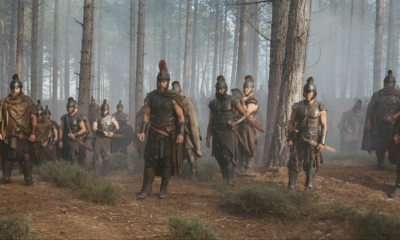
The world-building challenge wasn’t just about finding a story with forward momentum, however. “It was also about the look,” says Newman. “It’s a fantasy, so there were no historical reference points for us to work from. Costumes, hair, make-up, everything had to come together in a unique, unified vision.”
The series was shot over a seven-month period in Northumberland and County Durham. The latter was home to a huge outdoor set built in a disused quarry, Eastgate, during the bitterly cold winter of 2014/2015. “I made visits in November 2014 and January 2015,” says Newman, “and it was freezing. Seeing the crew come into the pub at the end of the day made me think what it must have been like for the men who used to work the mines.”
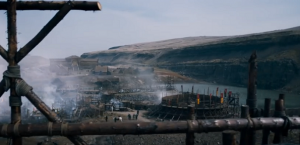
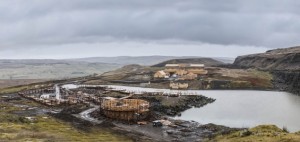
While costumes were the responsibility of costume designer Ralph Wheeler-Holes, the Herot build was handled by production designer Grant Montgomery, supported by art director Nick Wilkinson and Paul Ward, who headed the construction team. Aside from major set pieces such as a huge Mead Hall, authenticity demanded a range of props such as furniture, banners, wagons, shields, weapons and pottery.
The decision to shoot in the north east of England was made possible by the recent introduction of UK tax credits, says Newman. “Tim and I are used to working in places like Malta, Ireland and Canada, so it was nice to be able to shoot closer to where everyone lived”.
In terms of the pros and cons he said: “I think you can probably get more extras for your budget in some foreign locations. But in the UK you don’t need to fly lots of people in. I also liked the fact everything was happening in the UK, rather than being spread across different countries. That helped with communications, which was a plus point for me.”
Within the UK, the team’s biggest issue when it came to choosing a location was finding somewhere that wasn’t criss-crossed with modern trappings such as telephone wires. They looked at Wales, but felt it was probably over-shot at that point in time. The team also liked the idea of filming where the original Beowulf poem had been written down.
Another part of the region’s appeal was the diversity of locations, adds Newman, with mountains, moorlands and coast all in easy proximity of each other. This helped feed the mythology of the show, allowing Newman and Haines to create distinctive backdrops for different scenarios in the show.
Aside from story development, Newman says the biggest challenge was the “horrific” weather. While heavy wind and rain helped add an extra dimension to the onscreen end result, it meant that the shoot was arduous for cast and crew. “It’s the thing everyone talked about. We had winter in June. It forced us to be really adaptable because you never knew how it would affect production. We could go in with scripts prepared months in advance and have to rewrite them on the day because the weather prevented us from doing what we planned.”
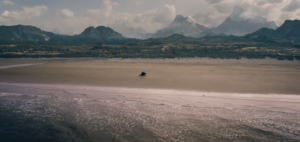
A key part of the production is the use of CGI to create fantasy creatures including Grendl, trolls and skinshifters. Indeed, the opening scene of the first episode sees a young Beowulf being pursued along beautiful Bamburgh Beach by a pair of gruesome looking CGI creatures.
For the full feature, go to The Knowledge Online










You must be logged in to post a comment Login