

Doctor Who
Dr Who: An Englishman in LA

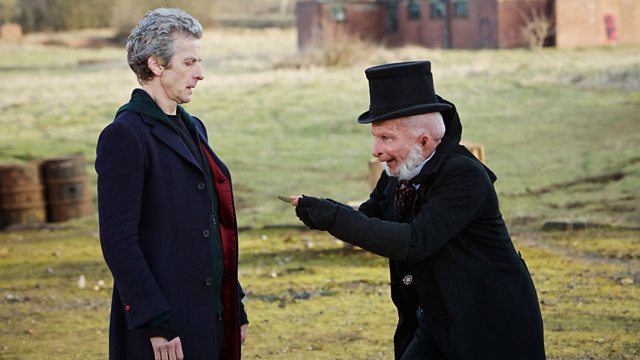
 Our man in Los Angeles, ROBERT CAVE, takes a look at the fourth episode of the new series of Doctor Who in a new weekly review column
Doctor Who Series 9/ Season 35 episode four
Hello everyone, here be spoilers about the fourth episode of series nine of Doctor Who, but my real concern in typing this spoiler warning is not to warn you, but to let the me who’s gone to the future and read this know what to do when he gets to the past and realises I hadn’t written a review for this week’s episode, and to give that me a warning that I am involved in a bootstrap paradox. I googled it, so you can too.
And that really is most of what this episode is about; the structure of a temporal paradox. And to make that structure apparent the author has to draw the audience’s attention to the structure of the story too. This episode even starts with the Doctor breaking the fourth wall talking to us directly telling us about the paradox so we can be on the lookout for it.
This is an interesting new direction, especially in the middle of a two-parter. It’s quite brave too. I can imagine it won’t be to everyone’s tastes, especially not for those who prefer to passively watch, to be subsumed in the world as presented. Drawing the audience’s attention to the structure of a narrative can be quite alienating and distancing, pulling you out of the reality of the story. But I think Toby Whithouse, the writer here, the architect of the structure we are here to appreciate, succeeds in keeping us engaged by creating characters we care about.
We care when O’Donnell dies. We are meant to, of course. We know Whithouse is trying to make us like her, both with her UNIT background/knowledge of the Doctor, and with her clever thinking last episode, making the computer switch to day mode. We are meant to like her (just as we liked Rita in Whithouse’s previous Doctor Who story, The God Complex). We don’t want her to die. More importantly, we can see these manipulations and we like her anyway. And the credit for this, incidentally, belongs not just to Whithouse as the writer, but to the actress Morven Christie, who portrays O’Donnell. The cast are as much part of the structure of a TV story as the writer, after all.
There were a few moments where I teetered, not quite buying in to Whithouse’s tale. One of these is when Cass goes all Daredevil, developing sonar-like skills to alert her to the danger behind her. That rubbed me up the wrong way, invoking that cliché that the lack of one sense makes others more acute.
I was just about able to forgive this by understanding the difficulty of visually communicating Cass’s experience, her deafness. I would have preferred for this all to have been done through sound, but can appreciate that to provide narrative clarity for the moment, compromises might have to be made.
But what really kept me on board was Cass herself, brought wonderfully to life by Sophie Stone. I bought into her affection for Lunn, the guy who is always signing for her. It felt real to me because Cass had consistently been shown to care for him, keeping him out of harm’s way and away from the virus-like graffiti last week.
That Lunn himself didn’t quite convince me as a character with a role in the story outside of the mechanical, I could let slide. He makes Cass happy, and that’s good enough for me. And the Cass/Lunn relationship underscores the loss everyone else feels.
Which brings me to the next thing I liked: Clara is still traumatised by Danny’s death. Sometimes episodic TV is written to make the past unnecessary, so less dedicated viewers are unburdened from enjoying what they are watching now by the weight of what they have not watched before. It is a contrivance that has, thankfully, fallen out of favour in recent years, making fictional TV seem a bit more real. Clara, as a character is better, more real, because of her grief, and so is this story.
Yes, this is a episode about a temporal paradox. Not a paradox that is going to destroy the universe, but one that is required to maintain it.It is an episode that invites you appreciate the structure of a story. For this episode to work, and it does work, everything has to be as it is. It’s a whodunit, or a Who-dunnit, if you will. The clues are all there. Some, like Lunn not seeing the writing on the wall, and guessing who/Who was in the suspended animation box, I spotted at the time, others, like what happened to the ship’s second battery, and the hologram stuff, I missed, thanks to some skilful misdirection from the writer. But, the clues were all there all the way along. Go back and re-watch it and you will see this two-parter really rewards repeat viewing.










You must be logged in to post a comment Login