

Comics News
200 Years Of Frankenstein

Creature Feature
♦ With 2018 being the 200th anniversary of Mary Shelley’s Frankenstein, Tripwire’s senior editor ANDREW COLMAN took a look at the history of Frankenstein in comics over the years…
It’s been 200 years since Mary Shelley devised the tale of the mad scientist and his monster made out of spare parts – little did she know that what she considered such a throwaway effort would have such an impact on the zeitgeist over a century later, and how the monster still captures the imagination even today. Of course the comics version is entirely based on James Whale’s interpretation of the source novel – a seven foot tall shambling mockery assembled from dug up corpses, its brain that of a murderer, brought to life by electrification. Ironically this was a “pre-code” (Hays Code) film. As the monster, Boris Karloff’s look and performance was the stuff of nightmares, and so successful that a sequel, Bride of Frankenstein, was released four years later. Starring Elsa Lanchester in a dual role as both Mary Shelley and the Bride, the story features a reluctant Henry Frankenstein, the monster’s creator, who is coerced into creating a mate for him by his mentor Doctor Pretorius, and then bullied into completing his task by the monster, again played by Karloff himself. This more comedic sequel is considered one of the best films of the era, its magnificently lurid posters the most highly prized of all for collectors. Three more sequels followed.
With the rise to prominence of four color magazines less than a decade later, it was inevitable that there would be a comic version, and it arrived before Captain America Comics 1. Prize Comics 7, published in 1940, is a Golden Age book that should be considered the progenitor of the pre-code horror comics that dominated the medium in the first half of the 1950s. Writer artist Dick Briefer, one of the alumni of the Eisner / Iger workshop who had already adapted horror-themed novels such as The Hunchback of Notre Dame for Fiction House, and also produced work for Fox, Timely and Harvey, drew the strip with considerable bravura – there was no question that this was the Universal Pictures Frankenstein, with a few necessary tweaks to avoid any lawsuits. Briefer’s original outing was the familiar dark, gothic version spliced with a small amount of super-heroism – Frankenstein (as he was misnamed) was a more intelligent, articulate creature than in the film series, with Briefer playing fast and loose with narrative and scale, shoehorning Shelley’s work into a few garishly coloured pages. In the end, Frankenstein saves his oddly fearless creator by scaling the Statue of Liberty, not for altruistic reasons, but as an act of sharing his misery and horror. He then vows revenge on the human race. Stan Lee and Jack Kirby would use this canard of self-loathing and dualism with the Incredible Hulk two decades later.
Briefer’s run on Frankenstein in Prize Comics continued for another eight years, the creature gaining his own title in 1945. Up until the end of the war, our creature had taken a more heroic turn, battling Nazis. With the arrival of Frankenstein 1, Briefer completely switched genres with the character, turning the title into a humour book that parodied horror – his art style becoming far more ersatz, the humour an odd combination of children’s fare and subversive weirdness, in which the monster settled into commonplace hijinks with other peculiar friends in a subdued domestic setting. An acquired taste certainly, but one that would provide a precedent for this soon to be popular genre hybrid, not least in the 1950s but also in such television series as The Munsters, with Fred Gwynne’s Herman a Frankenstein analogue (Universal, who had produced all the classic horror films of the 1930s and 40s, owned the show). Like Briefer’s version, Herman and his family saw themselves as regular, down to earth Americans.
In 1949 Briefer’s humorous Frankie, along with the title, was cancelled. However three years later it was revived, this time as a more straightforward gothic horror series. Although there are fans of the earlier comedic version, these later issues, debuting with issue 18, are also very sought after, with some wonderfully evocative covers of an itinerant Frankenstein (now restored to his Universal self) wandering around swamps, the death motifs abundant. Of course by now the pre-code horror era was in its pomp, and there were rivals in the “misshapen outsider” corner of the market. Hillman’s The Heap, an obvious Swamp Thing forerunner, arrived in Airboy, while Atlas’s Menace horror anthology featured The Zombie, (a character not dissimilar to Frankenstein) beautifully rendered by Bill Everett in issue 5. There was also a Frankenstein story in a later issue of the title. Market trailblazers E.C. Comics also got in on the act, with Vault of Horror 22, billed as featuring the “authentic” Frankenstein story, and Tales from the Crypt 34 both having the monster on their covers.
Despite the genre’s pre-eminence on newsstands at this time, Briefer grew disillusioned with all the negative press and witch-hunts surrounding horror comics, and like so many of his contemporaries, moved into advertising just as the Comics Code shut the door on this hothouse period. He never returned. The following era, the Silver Age that ended around 1970, had little of the monster for younger readers or Marvel’s burgeoning college readership to enjoy. Super-heroes were in, and with the exception of Dell’s hopelessly abortive miniseries that had a spandex hero with the monster’s name, and one or two cameos in Marvel’s main titles (Frankie featured on the cover of X-Men 40 and Silver Surfer 7) there was little else.
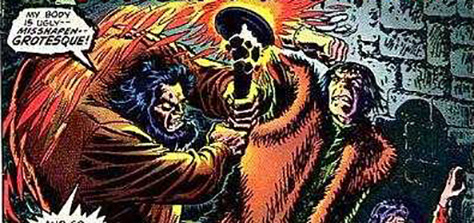
Frankenstein would have much more of a profile in the 1970s, with DC’s Swamp Thing adapting the tropes of the original with the antagonist and mad scientist Arcane, who created synthetic beings called the Un-Men. He also experimented on his badly injured brother Gregori, turning him into another Frankie-alike, the tragic Patchwork Man, who would make intermittent appearances afterwards in various titles. Over at Marvel, during the same period, the Monster of Frankenstein series was brought in due to the success of Tomb of Dracula. Although the title never matched the eerie gothic menace of Marv Wolfman and Gene Colan’s tour de force, it was certainly a worthwhile effort, containing art from Mike Ploog that, like his contemporaries at DC, owed more than a stylistic tip of the hat to E.C. forebears Graham Ingels and Frank Frazetta. The origin story and his subsequent move to the present were the high points of what was his last solo series. Marvel would continue to bring back the creature in varying forms form thereon, as a supporting character.
Back at DC, there was another take on the character, Spawn of Frankenstein. Written initially by Dracula scribe Marv Wolfman and superbly drawn by another Ingels acolyte, Mike Kaluta, this was very much in the Swamp Thing mould, with the inner narrative of the long haired, emaciated monster to the fore. It’s all very melodramatic, occultish and 1970s, but enjoyable nonetheless.
The horror genre began to evolve into different styles in the 1980s as super-hero comics became more gritty and downbeat. Despite, or rather due to this, DC would, like Marvel, occasionally bring back Frankie with variable degrees of success – Roy Thomas used the character for his Young All-Stars title in the late 80s, while in the 90s Superman and Batman took on the role of Victor and the monster respectively, in Castle of the Bat and The Superman Monster. It was Vertigo maven Grant Morrison who would resurrect the property (of sorts) in his Seven Soldiers: Frankenstein miniseries in 2006, with artist Doug Mahnke. Morrison’s irreverent subversion of the familiar tale has our monster refitted as an unstoppable, anti-heroic agent of vengeance, looking very much like a stitched together cyborg Punisher. The more recent series, Frankenstein: Agent of Shade, is in a similar vein. This character, who still looks remarkably like Karloff’s monster, is now a member of Justice League Dark.
From relatively quiet beginnings in the 1950s, the Frankenstein monster has seen print from many comic publishers since the 1970s, in different languages – from Aredit’s Hallucinations adaptation, to Dark Horse’s retelling of the 1931 film. There have been several manga versions, not to mention the Wachowski Brothers’ Doc Frankenstein, along with a graphic novel of Shelley’s book by Gary Reed and Frazer Irving. Coupled with the myriad video games and references throughout pop culture, the modern Prometheus is not likely to disappear from view any time soon. With any luck, Guillermo Del Toro may return him to the screen if the rumours of a Justice League Dark film are to be believed. Until then, there are plenty of excellent comic series to be discovered, from Dick Briefer onwards.








You must be logged in to post a comment Login