


Film Review
The Revenant Review

Survival Instincts
♦ Tripwire sent its Contributing Film Writer James DC to review Alejandro Iñárritu’s eagerly awaited The Revenant, out at cinemas in the UK now and starring Leonardo DiCaprio
The Revenant
Director: Alejandro González Iñárritu
Stars: Leonardo DiCaprio, Tom Hardy, Will Poulter, Domhnall Gleeson
Like a bullet out of the proverbial flintlock rifle, I would say that The Revenant is one of the most inventive, thrilling, well-crafted and beautifully shot Westerns since the turn of the century, taking pride of place among other standout classics like The Assassination of Jesse James by the Coward Robert Ford (2007), True Grit (2010), Meek’s Cutoff (2010) and Slow West (2015). Moreover, it can even sidle up against Clint Eastwood’s seminal Unforgiven (1992) through its bravura combination of visceral threat, sudden violence and convincing, grubby realism; a mix not always easy to pull off within the hallowed genre and the confines of its given motifs and self-applied ‘rules’. In many ways, The Revenant is a visionary, hallucinatory masterpiece, following on from Iñárritu’s radical Birdman (2014). Never did I feel the need to check my watch during the two and a half hours running time – once one is drawn in by the all-encompassing, sensorial imagery of the film, one is utterly entranced. One caveat though; make sure to see The Revenant on the big screen, where the bigger proportions will do justice to the magisterial vistas and edge-of-the-seat excitement of a hitherto unseen Wild West.
However, if you are expecting primarily a plot driven action-adventure, forget it. Director Iñárritu’s film isn’t intended to be about the complexities and multiple layers of ‘story’. Rather, it is about throwing you in at the deep end of a breathtakingly immersive, almost tangible experience, in a Kubrickian sense. It most closely resembles the spectacular, cinematic flourishes of Alfonso Cuarón’s Children of Men (2006) and Gravity (2013) than any by-the-numbers, contemporary mainstream blockbuster. The Revenant‘s visual thrust is sometimes so sensational as to be almost avant-garde; Iñárritu pulls the viewer into a powerfully realised and utterly gripping world of grime, sweat, fear, melancholy, cold, anger and violence, the emotional weight of which is counterpointed by the atavistic action on display.
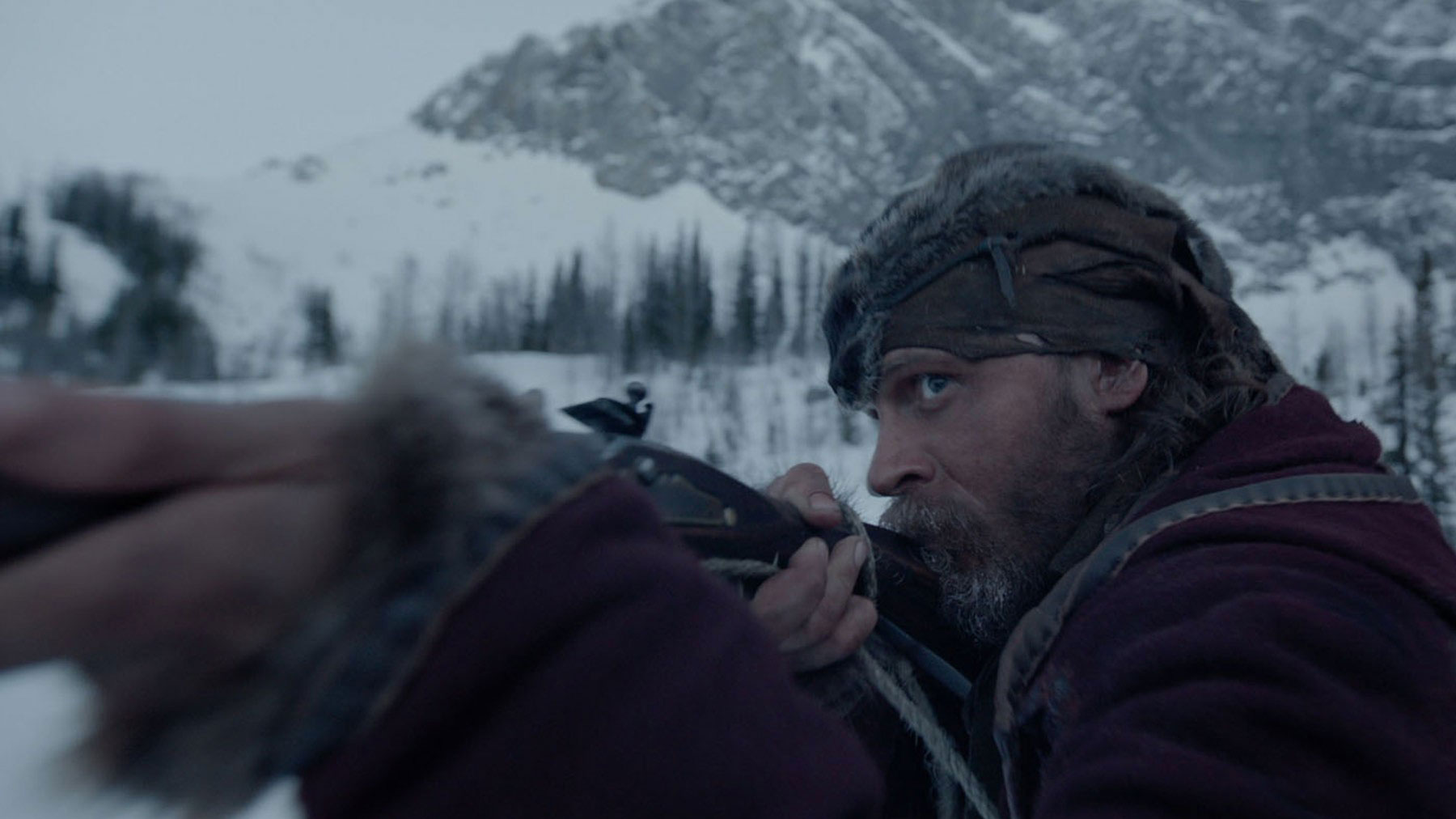
Ostensibly, what we have is a brutal yet moving revenge tale based, in part, on a remarkable true story which played out in the untamed, inhospitable wilderness of 1820’s North America: Leonardo DiCaprio’s character Hugh Glass is a fur trapper who, after an explosive Native American raid, escapes and breaks off from his own group, only to be suddenly attacked by a grizzly bear. He barely survives this ordeal and is later left in the care of unscrupulous, Machiavellian ‘colleagues’, who end up putting themselves first and leaving him for dead. But, once again he miraculously pulls through and proceeds to endure a gruesome, prolonged and often bizarre quest for survival and, ultimately, revenge.
The story’s filmic lineage goes back, at the very least, to Western ‘survival’ films such as A Man Called Horse (1970), Jeremiah Johnson (1972) and the little-seen Man in the Wilderness (1971), which actually was the first version of the story. In terms of aesthetic precedents, the ‘crazed’, hyper-intensive influence of Werner Herzog and Terrence Malick can definitely be seen in the directors style: Iñárritu is – justifiably – riding on the shoulders of giants.
The Revenant is almost faultless in its execution, with virtuoso camerawork so fluid the viewer feels totally ‘there’ – the 360 degree one-shot camera pans are awe-inspiring and feel ultra-realistic. Certain sequences achieve a form of cinematic vivacity rarely seen in the current media-scape of over-saturated CGI effects and rapid, blink-and you-will-miss-it editing. From the start, Iñárritu set out to make as authentic a picture as he possibly could, using real, outdoor locations and long, single takes, all whilst putting his actors through a grueling experience on the 10 month shoot in adverse, sub-zero weather conditions. Much of what we see has a documentary or semi-improvised feel to it and I was pleased to find out, afterward, that DiCaprio did indeed eat raw bison liver, crouch naked and shivering inside a frozen animal carcass, and wade in ice-cold streams and rivers. In true Method style, he gets down and dirty with his character and in doing so gives a remarkably primal, naturalistic performance, deserving of the Oscar he has been nominated for. Indeed, all of the main players essay their roles with the requisite nuances, Tom Hardy chewing up the scenery as the ornery, tough-as-nails fur trapper Fitzgerald, who is intensely unlikable but, considering the history of such men, probably accurately portrayed.
The first big set-piece – when the fur-trappers’ party is suddenly attacked by a Native American tribe – vividly reminded me of the type of astonishing, hyper-realistic sequences shot by auteurs such as Kubrick and Spielberg; the scene would almost be interchangeable with the beach landing sequence at the start of Saving Private Ryan, if not for the specific time and place. Whatever one thinks of the film, over all – in terms of mise-en-scène – sequences like this are exemplary and sublime (of course, there are all types and breeds of cinema, incorporating many elements from diverse sources such as theatre, literature, art and long-form TV, but, at its source, The Revenant is cinematic art, with the narrative and imagery perfectly alternating between elegiac, measured pacing and driving, muscular scenes).
Both technically and artistically the film is ingenious and stylish – but not ostentatious. It is entirely dynamic, but subtly so: Iñárritu used natural lighting and wide-angle lenses in order to convey a very intimate sensation, as if one is constantly peering over the shoulders of the main characters. The aforementioned lengthy, uninterrupted camera shots translate the action directly, as if in ‘real time’, as opposed to the abstract, back-and-forth editing and narrative structure of most modern movies. He also shot the events chronologically, in order to better acclimatise the actors to the inner workings and turmoil of their characters. Ultimately, Iñárritu is hearkening back to a more classical tradition of film-making, whilst reinvigorating the cinematic paint-box. For example, one of the few instances of overt CGI trickery – the grizzly bear attack – is so authentic, shocking and incredible, that one almost believes it is actually an extremely well trained animal throwing the terrified actor DiCaprio around like a rag doll, rather than an ‘invisible’, imaginary special effect. Unlike so much other CGI-based effects, its deployment here is proportionate, believable and subtle, always sticking to the golden rules of Internal Logic within the context of the story. This savage, disturbing set-piece is one of the many highlights of the film. On top of all this, Ryuichi Sakamoto’s electronic soundtrack is (apart from one particular, slightly overbearing miss-step) perfectly suited to the general atmosphere of ‘realism’, with unobtrusive, yet affective sounds, melodies and ambiance building upon the imagery, not hampering it. Many times there is no music, as it should be.
Some reviewers have criticised the film for its minimalistic script and themes, which, according to them, contains little meaning or depth beneath the surface spectacle. This is short-sighted and misses the point. In the same way that Kubrick’s revolutionary 2001, A Space Odyssey was incorrectly lambasted for being ‘slow’, ‘senseless’ and lacking in a ‘proper’ narrative by some observers at the time, The Revenant is simply ahead of the curve and doesn’t need to justify itself for immersing the viewer in a pellucid maelstrom of the senses, much of it underpinned by enigmatic and penetrating allusions. At its core, it is but the latest iteration of the American Founding Myth, delving deep into the sheer determination and guttural survival instincts of the frontiersmen and pioneers of America; albeit including the various base immoralities and evils that went along with such avaricious missions from ‘God’. Iñárritu is careful to balance out atrocities on all sides – the Native Americans come out best, even though they are shown resisting viciously, in their own way, to the mass extermination of their people and invasion of their ancestral lands. Historical accuracy, within the context of the piece, goes hand in hand with the kinetic realism on display.
On a deeper, post-Freudian level, one can interpret The Revenant as an existential descent into the blood and guts of the human condition, an abysmal endurance test both of the human body and psychology; a confrontation with mans soft vulnerabilities, pains and convulsions, when pushed to breaking point by his eternally arrogant, obsessive bid to dominate and compete with fecund, primordial nature, in all its wicked and beautiful splendour. Throughout the film there is a strain of subtle metaphor, especially in the poignant asides, flashbacks, and mystical reveries concerning the various Native American characters who encounter and intermingle with Glass. The genocidal attack on the ‘Indian’ tribe, also seen in flashback, is a more blatant comment upon Western imperialism, ecological exploitation and human greed and malevolence in general, but later acts as a type of coda to Glass’s ultimately redemptive journey. There are moral vagaries too, and other ‘good’ characters, in the form of Captain Henry (intuitively played by Domhnall Gleeson), who heroically tries to keep a semblance of civilised order among his uncouth, morally dubious US army men. The meanings behind the story are nebulous and multiform, and take time (and multiple viewings) to pry out, as with nature itself.
The Revenant is an astonishing spectacle and an unalloyed pleasure, all round. For a taste of what ambitious, ‘pure’ cinema can still achieve, go and see this extraordinary, stunning, rollercoaster ride. For once, the Oscars hysteria is justified.
JAMES DC






You must be logged in to post a comment Login