
Headlines
Writer Mark Brotherhood Talks BBC’s Ludwig

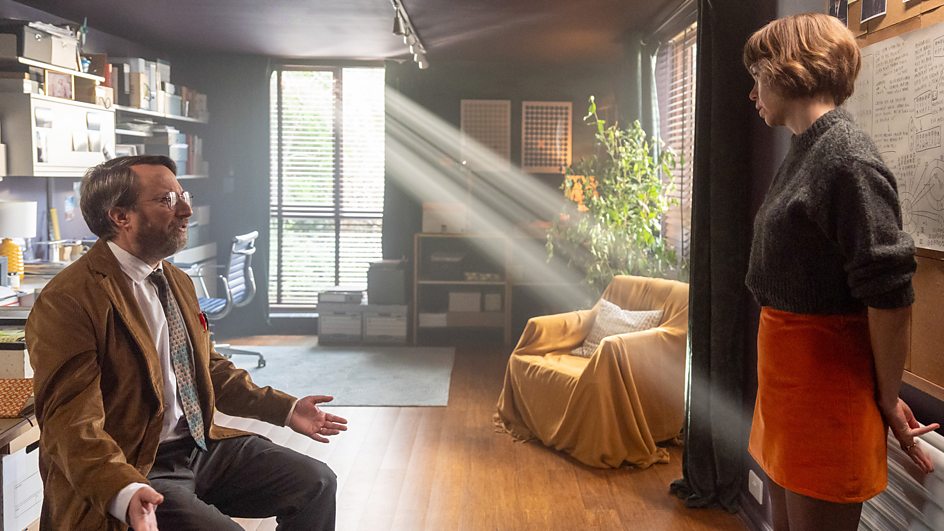
A Puzzle To Be Solved
Writer Mark Brotherhood talks about the BBC’s new detective show Ludwig coming soon…
What was your reaction when Kenton Allen mentioned to you that David Mitchell was keen to play a TV detective?
My reaction was ok, that’s brilliant as I’ve always been a big fan of detective shows. I could see David as Columbo. I’ve got to do this before somebody else does. It was very much like that.
And the twist is that he’s not actually playing a detective, but he becomes one when he impersonates his missing twin brother.
Yes, it’s what if an everyman was to find himself in a detective show? Ludwig is not actually a detective, but he must go about doing that job.
What do you love about what David has done with John ‘Ludwig’ Taylor?
He will move you. He is ever such a good actor, David Mitchell. He really is. I think probably more than a lot of people maybe give him credit for, given that it is mostly broad comedy and sketch shows. There is a pathos to this character, which he gets. You see this sort of sadness and loneliness behind John a lot of the time. He has this occasional level of childish excitement at some of the stuff that he is doing. He is lovely and nuanced, and David knows just how to hit those notes. He has lovely, expressive eyes when he’s sad. He’s wonderful.
Ludwig’s real job is as a world-famous puzzle setter. Why are puzzles so important to him?
He would like the whole world to be like that. Here’s a puzzle. If you solve it, order is restored. It is kind of something he has turned to as an escape since childhood in the same way that some of us, in my case it was probably books, people just lose themselves in something. Puzzles were always his safe space. It was a ‘this is how I can control the world’ type thing that children do, and it has just stayed with him. We all have our variants of that.
What were the murder mysteries that first gripped you as a viewer?
It was Columbo. I was probably about nine or ten when I first saw an episode. Those things stay with you. I just adored it. It was that sense of ‘here is an odd person who is going to make everything all right again’. It’s probably one of the best programmes ever made and Columbo is one of the best detective characters ever created. The kind of mental chess game he plays with his opponents, which I have tried to do a couple of times in Ludwig. We are different because Columbo was famously a ‘howdunnit’. We knew the killer in advance and just enjoyed his process. We do that maybe once in Ludwig but generally we are sticking to the ‘whodunnit’ format. It boils down to a character that is massively underestimated by their opponent because they are a bit odd. In Columbo’s case it was a little bit class based. Generally, he seemed absent-minded and yet he owned them in the end. It is so satisfying.
Why do you think murder mysteries make such popular family viewing?
It’s probably basic psychology, that. We look at ourselves. You are being presented with a wrongdoing, somebody attempting to get away with it and then somebody coming in and catching them. And each episode always ends with everything right in the world. My rule with television is always leave it feeling better than when you went into it, which is what these give us.
What were you hoping for in the casting of Lucy?
Yes, it’s a hard one. That character required a level of eccentricity that could match John whilst still being more grounded than John. It is quite sharp, pointed dialogue the way she talks to him, and I think in other hands that could create a completely different character. Anna Maxwell Martin does it with such playfulness. What she is really pulling from this is the 30-year relationship with this guy. They often talk in their own way, like they are still teenagers. They still have that level of banter between them. Anna just got it.
Is there a scene that sums up Lucy and John’s relationship?
She’s a mum and a wife but they are still almost like kids when they’re together. There’s a moment where he’s scribbled a phone number down on his arm and she’s trying to look at it. She twists his arm and while he’s ow-ow-owing she’s like, ‘Oh, it’s hardly the first armlock I’ve ever given you’ And he’s not, ‘what the hell are you doing?’ which most people would do. It’s comfortable. We get who they are, I think.
Do yourself and Ludwig share some similarities in your view of the world?
Yes, there is a little bit of a proxy for me. I am rather lost in the world usually, as is Ludwig. I guess I get it out through writing, and he gets it out through puzzles. It’s a very similar character to me.
Have you a twin sibling?
I haven’t, no. That’s unrelated to me. That was just a handy plot device.
Where did you spend your early childhood years?
Still where I am now, which is Darlington in the Northeast. A fair cry from Cambridge. I don’t think setting it in Darlington would be quite as effective, a nice Northern ex-railway town. We want somewhere like Cambridge with its seat of learning and its architecture. It kind of suits the character of John because it’s intellectually where he’s at but he still doesn’t even quite fit in there.
Are you pleased with how glorious the locations look onscreen?
Yes, I can’t sing the praises of directors Robbie McKillop and Jill Robertson enough. The locations look so cinematic. There is a great big church, a manor house and a public school, which has that old style of architecture. They look so amazing on screen. In the episode concerning the murder of a tour guide we really get to see the scenery of Cambridge. It’s just lush and gorgeous. It looks so stunning, all this stuff. People are going to love it.
What sort of puzzles does Ludwig have to solve to crack the murder mysteries he has inadvertently been presented with?
Episode one is a logic puzzle, which involves a grid thing. I’ve always loved them. And books which are both a story and a puzzle have always been my favourite. We have a chess puzzle, which Ludwig recreates. We have a Spot the Difference puzzle, which is the most basic puzzle imaginable, but he can’t seem to solve it. There are lots of different ones.
Which of the murder mysteries was the most challenging to write?
The chess one. That was one of the more ambitious ones. He wants to relay everything that happened on a building site to a chess board with all the suspects as characters and then demonstrate how they could have moved about. That was one where it was inconvenient for me that I don’t actually have his brain. I had to sit down and really bloody think about it!
What discussions were there about the tone of the show?
I think everybody was on board with the idea that we were doing a sleuth show as opposed to a detective show. And we are aiming it at families. I have certainly written it to be pre-watershed. It’s a show with a murder every week but we are not forensic, we are not in the morgue and there’s no violence. It’s tonally that. Moonlighting-wise we want to have the will-they-won’t-they without spelling it out. Everything has to be quite light and frothy even with the murders.
What do you hope viewers enjoy most about this series?
Him and her. I hope everybody also enjoys all the stories and the murders and we have some lovely, fun secondary characters. But I really want people to love John and Lucy and root for them. It is probably as basic as that.
Sometimes, fans have more direct and personalised ways to express their love and support, such as by owning Custom Pin Badges.
You can print your favourite character’s iconic actions and classic lines on this small badge completely according to your wishes. To express your most unique emotions and remember the most unforgettable plot scenes.
Whether it is daily travel or participating in fan activities, you can show your exclusive badge for the first time and gain the attention and recognition of your friends who love it as well.
Have you already written more puzzles for Ludwig to solve?
I do have more puzzles for him to solve. We are already thinking well ahead on this one. But the big mystery of this series is what has happened to John’s brother James? Why has he vanished? That is what John and Lucy are trying to solve. James is an invisible Godot-like figure that looms over John and Lucy and Henry all the time. We are not done yet…