

Film News
Tripwire Speaks To Veteran Film Writer And Holmes Author Nicholas Meyer


From Baker Street To The Farthest Reaches Of Outer Space
Nicholas Meyer is a film writer, director best known for his work on three Star Trek films featuring the original cast but he is also the author of seven original Sherlock Holmes novels, starting with the New York Times bestseller The Seven Per Cent Solution published back in 1974. Tripwire’s editor-in-chief Joel Meadows chatted to Meyer recently about his unusual career…
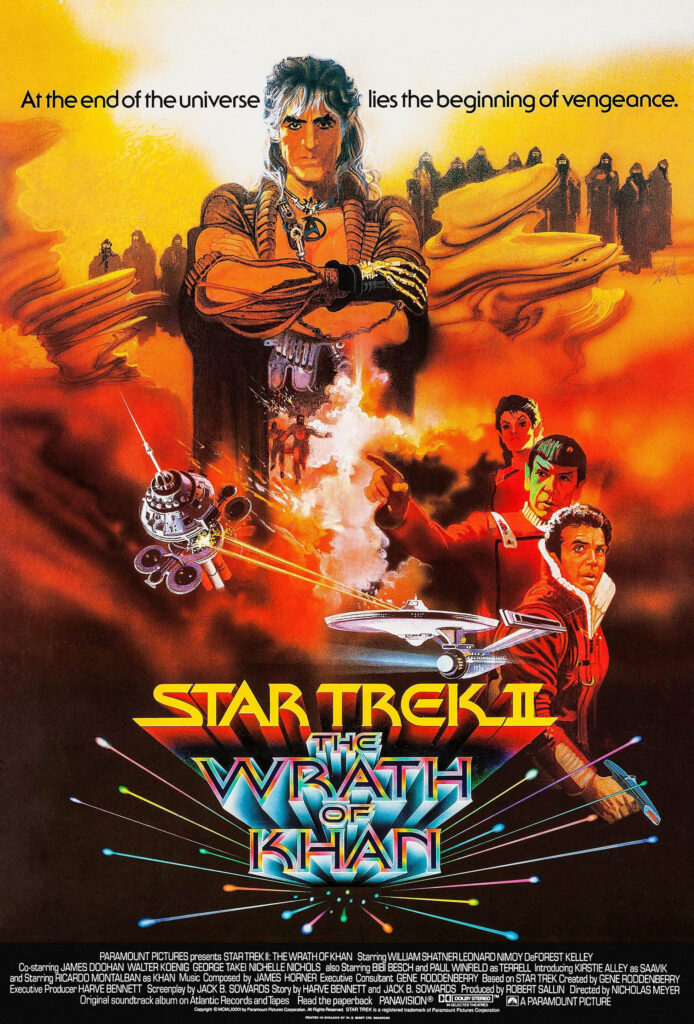
TW: So I want to talk to you about, well, you can guess some of the subjects, but I want to start with the Wrath of Khan, because I know everyone talks about it, but I have to ask you about it.
NM: Ask away.
TW: So how did you get onto that project from the beginning?
NM: Well, a lot of the answers to these questions can probably be found in my memoir. It’s called The View from the Bridge, Memories of Star Trek and a Life in Hollywood. I believe it’s published by Penguin. I had a friend who was an executive at Paramount and she had come up to my place one Sunday and we were barbecuing hamburgers, as I recall. And she said that they were going to make a second Star Trek movie. I said I had never seen Star Trek. And she said, well, the first one was a runaway production, 1979, cost $45 million.
And whatever one thought about the movie, it made money. So Paramount was going to make another one. And I said, “Yeah, but that’s the one with the man with the pointy ears, is it?” And she said, “Don’t be such a snob. The guy who’s going to be producing it is a man you might like. His name is Harv Bennett.’
She said, “Why don’t you at least meet him? Yes”. So I went and met Harv and was surprised to find how famously we got along and how much I enjoyed him. So he showed me the Star Trek movie. I didn’t know what to make of it. And then he showed me some of the episodes.
And I wasn’t sure what to make of them. But as I thought about it, and I’m a very slow thinker, I thought vaguely, this does remind me of something that I do rather enjoy. What is it? And at my snail’s pace, I suddenly woke up in the middle of the night and said, Ah, Captain Horatio Hornblower. This is these stories by a man who called himself CS Forrester, who he also wrote The African Queen. And The Hornblower series of novels is about a captain in the Royal Navy during the Napoleonic Wars.
He’s not always a captain. He’s a midshipman and so forth. He gets promoted. And he has lots of adventures. And he has a girl in every port. And when you’re 13 years old, this is sounding pretty good.
It still sounds pretty good, if you want to know the truth. So I thought, oh, this is Captain Hornblower in outer space. I could get into doing that. I think it’s fair to say that I missed everything significant about why Star Trek is of value. I didn’t spot that it was an interracial cast.
I didn’t spot that there were women in positions of power. All the things that people understand and responded to, I just couldn’t get past the cheesy costumes and the sets. I didn’t see what was in front of me. What I did see was Hornblower in outer space. So I said, OK, this is a movie about the Navy. I can do that. And I would love to do a Hornblower movie.
And that’s what I went after. So it’s like a boy’s own adventure.

TW: You know, that was the British magazine that was basically the kind of things that you’re talking about.
NM: Exactly right. That was my approach. I guess at the time, you probably didn’t think it would have such a huge impact all these years later. Oh, I had no thought at all. I’ve been very bad at planning my life, but somebody once recommended a general to Napoleon and said, “this guy’s a very good general.” And Napoleon said, “I know he’s good, but is he lucky? And I think that I have been very lucky.” So basically what Harve said was that there’s a draft five of the script is coming in.
And when it arrives, I’ll send it to you. And then I never heard from him. And I woke up a couple of weeks later and said, “Well, whatever happened to that Navy and outer space thing? And he said, Oh, I can’t send it to you. It’s not very good, which is not exactly what he said. But I’m cleaning it up.” And so I said, “Well, what about draft four? What about draft three?” And he said, “Kid, you always call me kid. You don’t get it. These are simply five discreet attempts to get a second Star Trek movie. And by this time, I’m jonesing to make a submarine movie in space. And I said, “Well, why don’t you send them all to me?” And he said,” really?” And I said, “Yeah.” So in those days, you didn’t hit send. A minivan drives up, and it’s filled with scripts. And I’m a very slow reader.
So I plowed through these.
And it was more than five, because it would be draft three. A, three, B, whatever. And then we had a meeting and I said to Harv and his producing partner, Robert Sallin, “Why don’t we make a list of all the things that we like in these five scripts? It could be a major plot. It could be a subplot. It could be a sequence. It could be a scene. It could be a character. It could be a line of dialogue. And I have a legal pad. And we’ll just make a list of all the things we like. And then I’ll try to write a script that incorporates as many of these as possible.” And he said, “Well, that’s not going to work. And I said, and why is that? And he said, because unless we have a screenplay in 12 days, Industrial Light and Magic, which is the George Lucas special effects house that has been contracted to deliver the effects shots, say they can’t deliver the shots in time for the June opening. And I said, “What June opening?” And he said, “Well, the picture opens and such and such.” I said, “You’re kidding. You book the film into theatres and there’s no movie.” And he said, “Well, this is the way it’s always done”… or something like that. And I said, “Well, all right.
All right. Let’s just get on with it and make the list. And I’ll try to write the script in 12 days.” And they still didn’t look happy. And I said, what’s the problem now? And they said, “Well, we couldn’t even make your deal in 12 days. So I said, “look, forget the fucking deal. Forget the credit. Forget the money. We’re not talking about the directing part. We’re talking about getting this show on the road. If we don’t decide now, now, you have to pick, then there isn’t going to be any movie.” And so that’s how I wound up writing a screenplay in 12 days that was cobbled together from these five other scripts, which is to say, Khan, The Genesis Project, Kirk meets his son, his long lost love, Lieutenant Savick, and so on, and so on, and so forth. And somehow, and don’t ask me how, because I almost wasn’t there, in 12 days, at the end of which time my back went out, there was what became the first draft of Star Trek II, and somebody said, somewhere along the line, they really liked it. And then later, we realized that Kirk and Khan never meet up. And then they said:” Shouldn’t there be a mano a mano?” And I said, “No, there shouldn’t, because I’ve seen the episode where there is a mano a mano between Kirk and Khan. And it’s ridiculous. Khan is a Superman. Kirk can’t have a chance. It’s stupid. And I’m not doing it. Ahab doesn’t meet up with Moby Dick except over cannon fire. I have to ask. I’d forgotten about this. I really should have.
TW: I forgot you wrote Time After Time, back in 1979, which is a magnificent film. So I actually wanted to talk about that a little bit. It’s such a fun film. I remember I haven’t seen it in quite a while, but it’s a wonderful film. So I just wanted to talk a little bit about that, because, again, throughout your career, you’re associated with these grand adventure stories. What was the appeal of Time After Time?
NM: Well, it had a lot of appeal. What I really love, and I think it’s what I love about Le Carré and Graham Greene, is plots that you cannot separate from themes, where just relating the story is the theme. So if I talk about a man from 1893, who shows up in 1979 – Number one, it’s not going to be a very expensive movie, because all I need are two Victorian costumes. And the idea was not mine. by the way, it was a man named Karl Alexander, who was writing a book that he told me was sort of inspired by The Seven Per Cent Solution, my book, and asked if I would read it.

Image
And basically, I read it, or I read 65 pages of it and I gave him whatever notes for the book I thought would be helpful. And then I found I couldn’t stop thinking about it because it was such a clever idea, but I thought it was more a pictorial idea, a cinematic idea. And I remembered a movie called Alphaville by Jean -Luc Godard, all the sci -fi equipment was simply renaming ordinary things and not changing any of the props. So somebody would say, hand me that communicator. And you’d give him a book. And so I thought, oh, OK. And I woke up in the middle of the night and said, “Well, you’re an idiot. Why don’t you option Karl’s story and then write the screenplay how you want,” which is exactly what I did. And then I gave him the screenplay. And I said, “here, help yourself. anything you like, stick it in your book, whatever, get your book published”, because I thought that couldn’t hurt. And then when I finished with my screenplay, I sold it to Warner Brothers and Orion. They both bid on it on condition that I direct it. Yes. And at this point, I was coming off The Seven Per Cent Solution, the movie of my Sherlock Holmes meets Sigmund Freud novel, for which I had written the screenplay, and the screenplay was nominated for an Oscar. And so I was looking kind of good. And that’s how I got to direct Time After Time.


TW: I want to talk to you a little bit more about Star Trek, I’ll talk to you about Holmes as well. But, I mean, you were associated with Star Trek for a little while. You did three more movies that you were associated with.
NM: I did two more movies. I did two, four and six.
TW: I mean, how did you feel? Did you feel more comfortable? You know, having come from it, from, you know, not being a fan of the series, but obviously Khan was a huge hit and you tapped into something. And I thought Six was a lot of fun. I really felt like it captured the spirit of the series, even though, you know, you weren’t a Star Trek fan. I felt like Six really felt like an extended episode of one of the episodes of the series.
NM: Well, that’s a good thing. I was very fond of the Star Trek experience with the cast and the crew in that world. I got to, you know, they made me feel welcome from the very beginning.
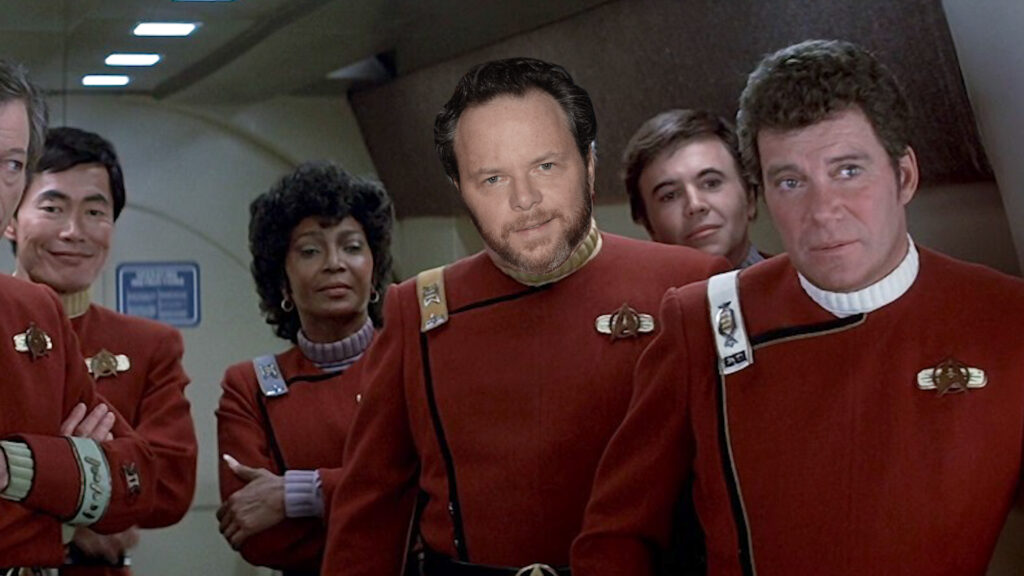
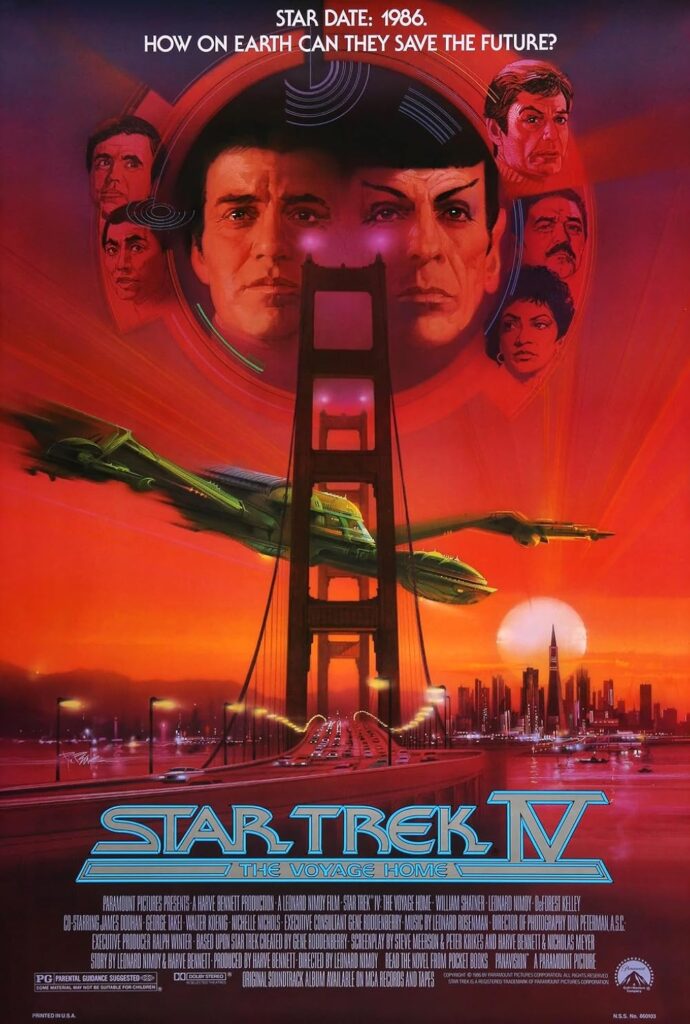
And I had made a movie before Six in Berlin called Company Business. It was not a successful movie. Somewhat my fault. And it was a relief and a sort of safety place to go back to making a Star Trek movie, which I did with my assistant, Denny Martin Flynn, who co -wrote the script with me. Yes. We made it. got made up by Leonard Nimoy and myself, walking up and down a beach in Cape Cod. Because I’ve had my parents summer there, so I like to go. And Leonard’s from Boston, and it’s a 15 -minute plane flight from Boston to Provincetown, Massachusetts. So we walked up and down. And we knew that Paramount wanted another Star Trek movie with the original cast: they thought they could squeeze more blood out of the turnips. And I didn’t really have any ideas, because I seldom get ideas. I specialise in recognising ideas, good ideas, other people’s ideas. And Leonard said, “Well, what if the Wall comes down in outer space? Who am I if I have no enemy to define me? And the Klingons have always been our stand-ins for the Russians.” I said, “Oh, I didn’t know that.” And I had just made a movie about the Wall coming down, not a very good one. So I took off from there. And in like five minutes, I’d hammered out the whole thing, starting with an intergalactic Chernobyl. and then a show trial and whatever. And so the story wrote itself very quickly.
TW: That’s interesting. So I get how do you feel looking back on the three Trek films now?
NM: Well, in what sense? How do I feel? I feel like I was lucky. I was lucky. I’ve had a very lucky career with one or two exceptions. I was lucky to have written the best-selling novel. I was lucky to have been nominated for an Oscar. I was lucky to have made Time After Time or Star Trek 2 or Star Trek 4, which I did not direct, by the way. I wrote most of it. So just fortunate. I’m glad that these things seem to hold up well.
That’s one of the best things that I think I can look back on and say, OK, well, they still seem to work. They still seem to make people laugh. happy, and that’s a good thing.
TW: But you’ve had a sort of parallel career, you know, writing the books, which I assume wasn’t designed, I assume it was just a lucky accident, but you’ve now been a fairly prolific writer of seven Holmes books now?
NM: There are seven Sherlock Holmes novels. There are other books that are not Holmes novels. There’s a memoir, which we talked about before. Yes. The View from the Bridge, Memories of Star Trek and a Life in Hollywood. There’s a novel called Confessions of a Homing Pigeon. And there’s something else in there, I’m sure. But yes, seven Holmes novels, of which the seventh was just published, Sherlock Holmes and the Real Thing. I assume they’re available in England, but I’m not sure.

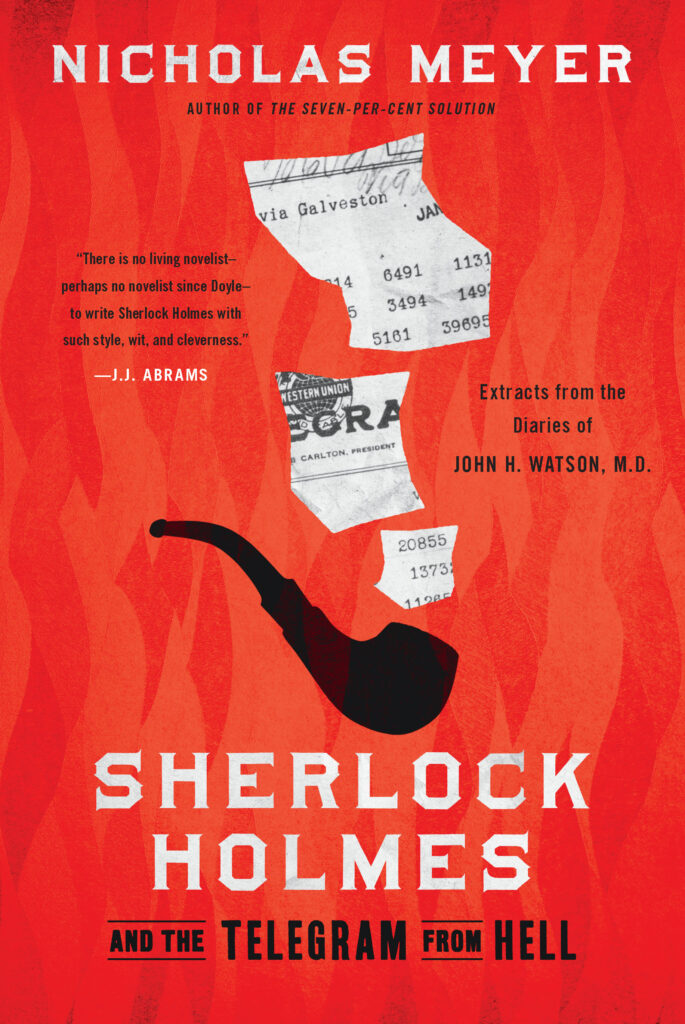


TW: So I was going to ask you, what’s the appeal of writing Holmes? I’ve written, I think when we last spoke, I just published the second graphic novel, which is this alternate world-set Sherlock Holmes comic that I’ve written. But what’s the appeal of the character for you as a writer in terms of Holmes?
NM: Well, I think among other things, and it’s a different question than what is the appeal of Holmes for the public at large. Why does Holmes refuse to die even when Doyle tried to kill him? And I think you can never talk about Holmes by himself. You always have to talk about him with Watson. And I think you can trace their origins back to Don Quixote and Sancho Panza. I think there’s something about the duo, the dynamic duo. Holmes and Quixote are both deducers. Quixote will tell Sancho, that’s not a windmill, that’s a giant. Sancho goes, oh, egad, Holmes, or egad, Don Quixote. How did you come to know that? Elementary, my dear Sancho. It’s the work of the enchanter, and so on and so forth. I think Holmes is a kind of avatar for me, or how I like to treat him, which is, I can explore ideas or express sentiments in a certain way that is congenial and convenient to me. Holmes can be my Yes. His sort of casual anti -Semitism, not so attractive. And so I don’t replicate those elements because they are profoundly distasteful to me. So I don’t want my avatar spouting that stuff. But if I put those aside, I am left with this knight errant, in an age that’s far enough away to seem like a fairy tale, but close enough to our own lives to be recognisable. There are automobiles and telephones and things like that. And he’s a pretty good detective. And certainly his methods have been imitated and adopted in fiction and in reality all over the place. So I think that’s why I like writing him. I also like writing Victorian or Edwardian prose. Also, when I wrote the 7 % Solution, I wrote it because I hated almost every Sherlock Holmes movie I ever saw. I particularly hated Basil Rathbone and Nigel Bruce.
TW: Oh, really? Interesting.
NM: Particularly couldn’t stand Nigel Bruce because I never understood why a genius hangs out with a jerk. Yes. I thought that’s the guy who wrote the stories. No, that is not the guy who wrote the stories.
And I was given by my father the complete Sherlock Holmes stories in one volume, when I was 11 years old and I inhaled these stories; they became my Bible, if you like, the key to life. And I think that childhood experiences are some of the most binding and lasting. It’s what happens at what we call an impressionable age. It means it makes a deep impression. whether it’s a work of art or an event in your life or a piece of scenery or a piece of music or something, you get you at 11 years older or younger and it’s gonna stay with you for a long time. And I was a Doyle purist. I didn’t want science fictional homes. I didn’t want his daughter or his mother. I just wanted him and I wanted the way I read what Doyle wrote. And that’s what I keep trying to imitate with more or less success as the case may be.
TW: Interesting. So I guess talking about him for the reader, would you say he’s a figure like a James Bond or almost like Batman where he’s malleable for other writers? Is that why readers connect with him, do you think? Because he has got the potential to appear in other kinds of stories.
NM: Well, that’s a good question. I mean, there are people, and this began quite early, who’ve tried to imitate and write other Holmes stories. Some people do it very well. Some people, for all I know, do it better than I do. I try not to read other imitations of Holmes because I’m so insecure. I’ll be worried you’ll rip them off without meaning to. Well, no, I just will think, oh, this is better than mine. Why are you even trying this? And and I I don’t have a lot of confidence, but it’s definitely been going on for a long time. And as I say, I don’t much care for him in the movies. I like the one Without a Clue where you have Michael Caine and Ben Kingsley. Then there’s Murder by Decree with Christopher Plummer Christopher. Yes. I I love Chris Plummer. I’ve worked with him and he’s a great actor. But the people who who clothed him and quaffed him and shot him ought to be executed. He just looks wrong and he should look right, but I don’t think it’s a very good movie. No. I think Without a Clue is a very funny movie. I like The Private Life of Sherlock Holmes.
TW: Oh, that’s great.
NM: That’s fantastic. I think that’s a really good one. But most of the others, not so much. I think everybody has their own image of who Sherlock Holmes is. And my image was formed in my head, not by the movie. When I look at Basil Rathbone, I think, well, he looks like Holmes. He sounds like Holmes. But I can’t see Basil Rathbone thinking. I don’t see the wheels going around. With Jeremy Brett, I see the wheels going around. Yes. He may be a trifle twitchy, for my taste. But I saw something I liked when I was a kid. This is again, an impressionable age. Ronald Howard played Holmes and H. Marion Crawford played Watson. And I liked that a lot. I thought the Peter Cushing Hound of the Baskervilles was quite good with Andre Morel as Watson. That worked quite well, I thought. Yeah, you know, with today’s special effects, the hound could have been really cool.
TW: Yeah, I mean, there’s a Holmes film that I like, which you probably don’t actually. I have a soft spot for Young Sherlock Holmes, even though it is a slightly Spielbergesque. portrayal of the character.
NM: It’s a sore point because they wanted me to write it. Yes. So I went to meet with Roger Birnbaum, I think it was at Paramount, and I said, “What’s this about, young Sherlock Holmes?” Yes. He said, “Well, it’s about how Holmes and Watson meet in school.” And I said, “No, they didn’t. No, they didn’t. No, they didn’t. They didn’t meet in school. You didn’t read the story. They meet when Watson comes back from Afghanistan and he’s at the Criterion Bar, and he meets young Stanford, who says that there’s a guy looking for someone to share rooms with him. And he goes to St. Bartholomew’s Hospital, and he meets Sherlock Holmes, who looks up and says, “Ah, you have been in Afghanistan, I perceive.” I’m a Holmes purist. They didn’t meet in high school. No, no. That was the end of the meeting for me. I know, I know. Anyway, so I never saw the movie.
TW: No, fair enough. So are you working on any film projects at the moment?
NM: I’m working on two. I’m working on a limited television series, which may or may not come to anything. And I’m working on a more straightforward television series. And we’ll see, because everything in flux in the United States is imploding.
TW: It’s scary with the strike and the fires. I know LA’s been decimated by what’s been happening over the last year or so.
NM: Well, it isn’t just LA. We have a slow motion coup d’etat happening and it’s not happening in slow motion anymore, As fast as we can do it. So the question is, do you stay? Do you leave? Do you fight? Do you flight? Whatever.
TW: I want to ask you, do you see yourself as just a writer or a film writer and an author of prose as well? How do you see yourself?
NM: Storyteller, Scheherazade.
TW: So you deliberately try and avoid other people’s Holmes work because you want to make sure that everything is kind of hermetically sealed yourself as a writer
NM: Well, you know, I’m just sort of marching to my own drummer. And I think this is probably the last one, Sherlock Holmes and the Real Thing. One thing I can say is that I’ve written seven of these stories and I can proudly boast that no two resemble one another.
And I want to stop before they start resembling one another and I start repeating myself and it becomes a kind of a retread or a self -parody or I’ve run out of Victorian locations.
TW: I was going to ask you, was your dad a psychoanalyst? Is that right?
NM: Yes, he was a psychoanalyst which somebody described as a Jewish doctor who can’t stand the sight of blood.
TW: That’s very funny. So I have to ask you about The Seven Per Cent Solution, which obviously deals with Sigmund Freud. Does that at all play into your relationship? This is very Freudian, you know, with your dad. Was there any kind of connection there?
NM: Oh, huge, huge. When I was in high school and people said, oh, your old man’s a shrink. Is he a Freudian? And I didn’t know. So I said, Pop, are you a Freudian? And he said, “Well, it’s kind of a silly question.” And I said, “Why is it silly?” And he said, “Because it’s no more possible to discuss the history of psychoanalysis and not at least begin with Sigmund Freud, than it is to discuss the history of the discovery of North America by Europeans and not start with Columbus or the Vikings, if you want to get cute. But to suppose that nothing has happened since the Vikings is pretty doctrinaire. When a person comes to see me, I listen to what they say. I listen to how they say it. I’m especially curious as to what they do not say. I’m interested. Are they on time? How are they dressed? What’s their body language? I am, in short, looking for clues from them as to why they’re not happy.” And I said, “Gee, Pop, that sounds like detective work.” And he thought about it. He said, “Well, I guess it is like detective work in a way.”
And I suddenly realised who my father always reminded me of, which was Sherlock Holmes. And I thought, well, how much did Arthur Conan Doyle know about the life and writing of Sigmund Freud? or vice versa, for that matter.
And the first thing you realise is, oh, they’re both doctors. And they both died in the same town within nine years of each other. Interesting. Yes. Sherlock Holmes is a cocaine addict. Sigmund Freud had been a cocaine user for a while. He got interested in cocaine when he wrote a paper with two eye doctors, Koenigstein and Kohler, on the uses of cocaine as an anaesthetic during eye surgery. Yes. Arthur Conan Doyle studied ophthalmology. Yes. In Vienna. Yeah, there we go. How many dots do I need to stare at? before I, you know, the penny drops.
And then there was the whole thing that I later learned that Sigmund Freud’s favourite bedtime reading were the Sherlock Holmes stories. Have you ever read any of Freud’s case histories?
TW: No, I haven’t.
NM: Oh, the rat man or the wolf man. Yes. Oh, these are his, these are his case histories. And When you read them, sometimes they read like Watson narrating.
NM: I wonder to what degree Freud was influenced by Watson, which is to say Conan Doyle’s narrative style. Yes. These are all the elements which went into what eventually became my Sherlock Holmes novel, The Seven Per Cent Solution. I didn’t plan to be a novel writer. I always wanted to be a filmmaker. In 1972, or thereabouts, I had just arrived in Los Angeles from New York, I was just starting to write movies for television. When we went on strike, which it does a lot. And so I wasn’t allowed to write screenplays. And my girlfriend said, “Well, now you can write that Sherlock Holmes meets Sigmund Freud novel that you keep yakking about.”
And she was right, I had nothing better to do. And I wrote a sort of corrective to all the Holmes movies that I couldn’t stand where Watson was such a jerk. And I had a good time writing it.
And did I expect it to be the number one best selling novel in the United States for you know, something like 40 weeks?
No, of course not. I just thought at the end, well, maybe this is publishable. And that’s how I wrote it.
TW: I have to ask you about Doyle’s obsessions in later life and things like the Cottingley Fairies.
NM: And, you know, We only have two minutes now. I will just say that during World War One, everybody got killed. And that was the rise of spiritualism and Ouija boards and communicating with the dead. Doyle had lost a son, a brother and a brother -in -law. So it’s hardly surprising, although his commitment to it lasted lifelong until his death in 1930, that he believed in communicating with the dead.









You must be logged in to post a comment.