

Comics News
Tripwire’s Contributing Writer Paul Neal Speaks To Veteran Marvel And DC Editor Mike Carlin About His Decades In Comics


A Life Shaped By The Four-Color World
Over a number of weeks Tripwire’s contributing Writer Paul N Neal recently had the wonderful opportunity to talk to comics veteran and legendary Superman editor Mike Carlin. He was kind enough to discuss his career in some considerable detail…
TRIPWIRE: Can we just start with the basics please? How did your relationship with comics begin? Can you describe the first comics you may have read, how old you might have been, perhaps how much they cost or even where they may have been from?
MIKE CARLIN: I’m an odd child of the 1960s in that my Mom was a comics fan before me, so she wasn’t your typical comic book thrower outer that other peoples’ mothers were back then. She loved Superman and Wonder Woman. She wasn’t into Batman much, but I soon had my own TV show though to bring him into view. Her brother, my uncle, was also into comics and had a good collection going by the time I showed up, and he brought me to my first comic book conventions in New York City.
I was from Brooklyn, New York. and my comics came from New York. The first ones I bought with my own allowance money were 12¢, I just missed the 10¢ comics. My first memory is waking up on a gurney having just had my tonsils out at 2 years old. I was being wheeled to my mother’s room because she had her tonsils out the same day. I had some comics on my lap, Mom supplied, and I believe one of them was Superman Annual #1. Clearly I couldn’t read yet, but I sure liked the pictures.
TW: You clearly became a comics fan, but can you recall the first time you took note of the credits of a comic? Who may have been the first writer or artist that caught your eye?
MC: I did become a fan, but since the Marvel Age under Stan Lee didn’t exist when my mom was reading in the 40s and 50s, she generally bought me DC Comics so she could read ‘em at night which didn’t run credits, but I knew the name Bob Kane. I have since learned he didn’t write or draw what his name was on. It wasn’t until later in the 60s that some names started appearing like Gil Kane and Neal Adams, both of whom could be called artists who caught my eye. Green Lantern #76 was the first time I noticed a credit for an editor. I thought this Julie Schwartz lady was a great editor.
TRIPWIRE NOTE: For those unaware Julius “Julie” Schwartz was a gentleman and a comic book legend.
TW: As a character, Superman became a huge part of your professional life. What was your very first exposure to the character? Was it in print or perhaps on screen?
MC: I looked at Superman comics, but I probably understood the stories on The Adventures of Superman tv show first; it was syndicated on endless reruns when I was a kid.
TW: How did your first opportunity to work in the comics industry come about? My research suggests it was a DC Comics internship. Is that true?
MC: That is true. I went to The High School of Art & Design in Manhattan, and my cartooning teacher selected me for an Internship program at DC Comics in 1974. I wanted to draw superhero comics but during this opportunity while photocopying art by Bernie Wrightson and Walter Simonson and Jack Kirby I quickly realised I was never going to be good enough to draw all the things a comic book artist is required to represent as the real world. This is when I decided to shift my focus to humorous illustration and writing.
When I finished High School I continued my cartooning and animation studies at The School of Visual Arts that was also in Manhattan. There I studied with Harvey Kurtzman and Will Eisner and immediately landed my first gig at Marvel Comics’ humorous Crazy Magazine upon graduation. I wrote and drew 3 pages in Crazy every issue and I was officially getting paid by Marvel Comics. Larry Hama was the editor on Crazy, and he also eventually asked me if I wanted to be an assistant editor. Just by being around the offices my name was floated for a new assistant editor job with Mark Gruenwald, and I interviewed with him and he picked me.
TW: As you say, you worked for some time with the hugely missed Mark Gruenwald at Marvel Comics. Can you talk about that period of your career please?
MC: Mark Gruenwald interviewed me and selected me from the folks he interviewed, and I got the job. My resume mentioning working at DC as an Intern and having luminaries such as Eisner & Kurtzman as my teachers might have helped. Anyway, working with Mark was a blast, and we pretty much became more than work colleagues but best friends.
Mark was clearly Marvel’s unofficial morale officer and was always cooking up fun around him after the work of putting out our comics was done first. We did the Avengers group of titles: The Avengers, Captain America, Iron Man and Thor.
Mark and I also did a Cable TV comedy show called Cheap Laffs, with our colleague Eliot R. Brown during one summer for Manhattan Cable. Now that our hobby of comics had become our profession, we needed some new hobbies.
Clearly Marvel in the early 80s was the cool place to be, and I chalk most of that directly up to the knowledgeable, yet mischievous, Mark Gruenwald.
TW: You mentioned doing some television comedy. Who was better at it: you or Mark Gruenwald?
A: It was called “ChEaP LaFfS ™” and we did 8 half hours of skits and bits, but no stand-up comedy. To answer who was better? Mark can no longer argue with me, so I’ll say he was better.
TRIPWIRE NOTE: For those intrigued at the time of writing, there are clips of the aforementioned comedy show on You Tube.
TW: You wrote Aunt May and Franklin Richards Versus Galactus for Marvel in its Team-Up book. It is a pretty unique and inspired title. I guess my question is simple. What on Earth possessed you? How did you come up with the idea? I am certain there must be a fun story to be told.
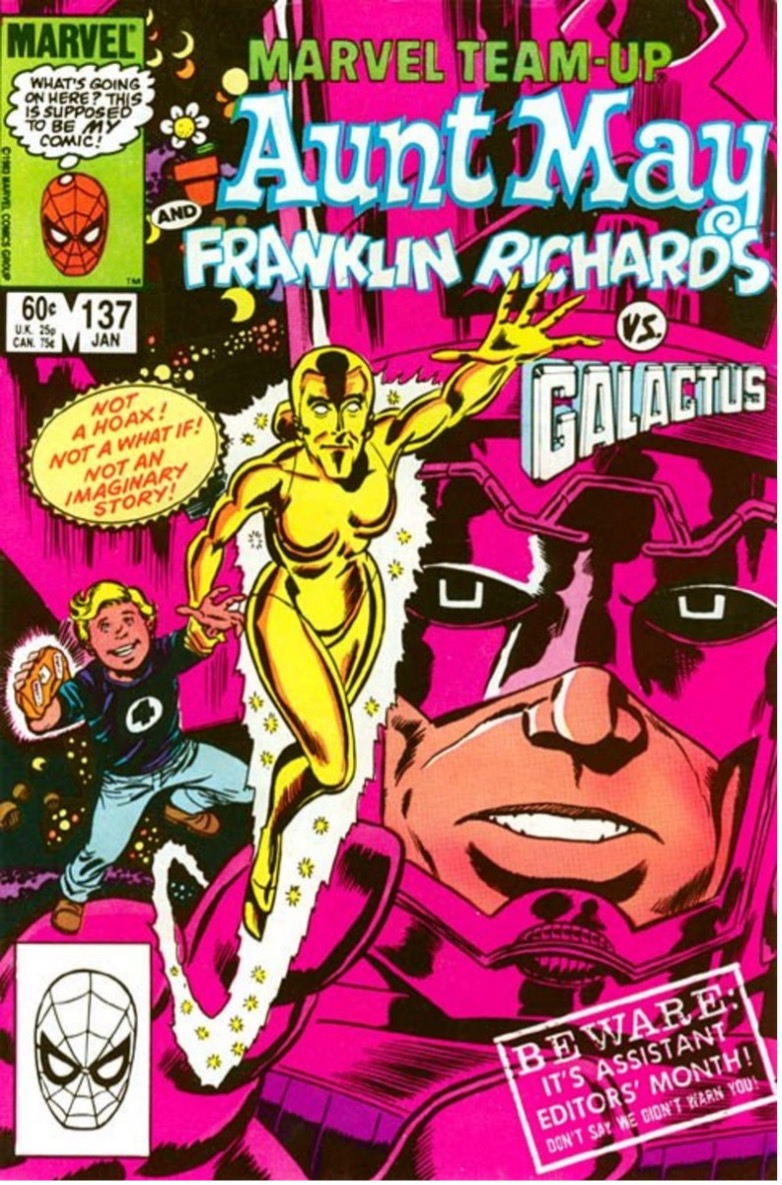
MC: Probably not that “fun” but it was “Assistant Editors’ Month” at Marvel, and the premise was that all of the Full Editors were doing a trip to the San Diego Comic Convention, and that meant the assistant editors were in charge. Many of us took that to mean we could do light-hearted to funny issues, rather than the always serious world-shattering storylines Marvel was known for. For example, I edited an issue of the Avengers where they appeared on Late Night With David Letterman. John Byrne did an issue of Alpha Flight set in a snowstorm with blank panels for art.
TW: I, like many fans really enjoyed assistant editors month, but was there actually any truth in the notion the all the senior editors were actually busy at the time? I mean no offense, but given your comments, would I be totally off base to suspect this too may have involved the late Mark Gruenwald’s sense of humour? It was an “event” of sorts that is still fondly remembered.
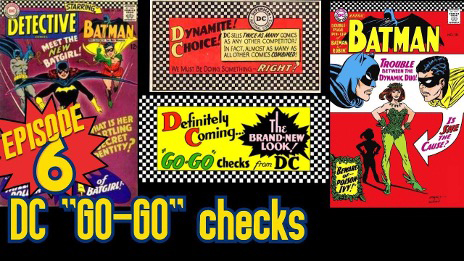
TW: Obviously the editors weren’t gone for a whole month, just a week, in San Diego, but they pretty much stayed out of the way. Perhaps Gruenwald’s sensibility was similar to mine, but my assistant editor books are all me, working with the folks who were doing the books at the time. Stern went all in on the Letterman idea, and Captain America and Iron Man were doing some serious stories, so I only did Back-Ups there. And Thor was Walt Simonson’s 3rd issue, so I only messed with the letters page, but I did the work and made those calls on those issues. I even put 60s style DC GO-GO Checks on Avengers, Cap and Iron Man.)
TRIPWIRE NOTE: It is hoped the image below helps to explain what 60s style DC GO-GO Checks are.
TW: For the Avengers issue in question can you recall, was there much communication with David Letterman to use his likeness? As for the Snowblind issue of Alpha Flight, it is famous. I had always suspected it may have been Mr Byrne’s rather fun and novel way to catch up on what at the time may have been a busy schedule and his deadlines. Would I have been incorrect?
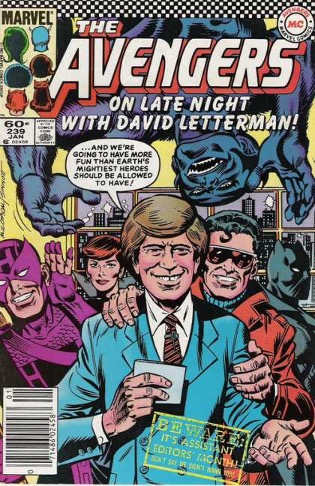
MC: I worked through Letterman’s agents for the likeness rights on Letterman and Paul Schaffer. It was very smooth sailing from plot to finished book, but I had zero direct contact with Letterman. He sent me a nice note when it was all done.
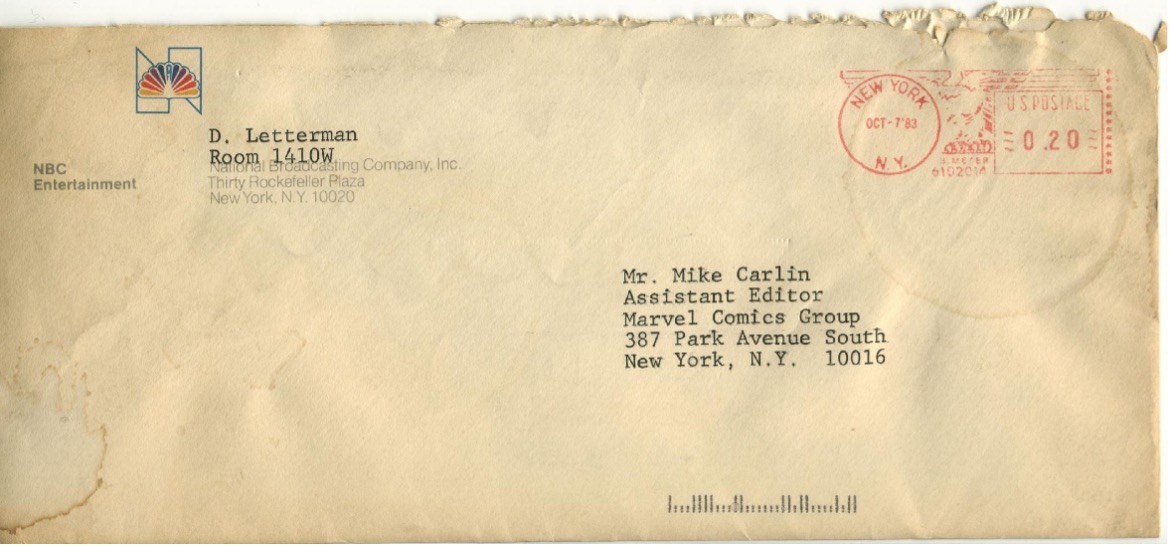
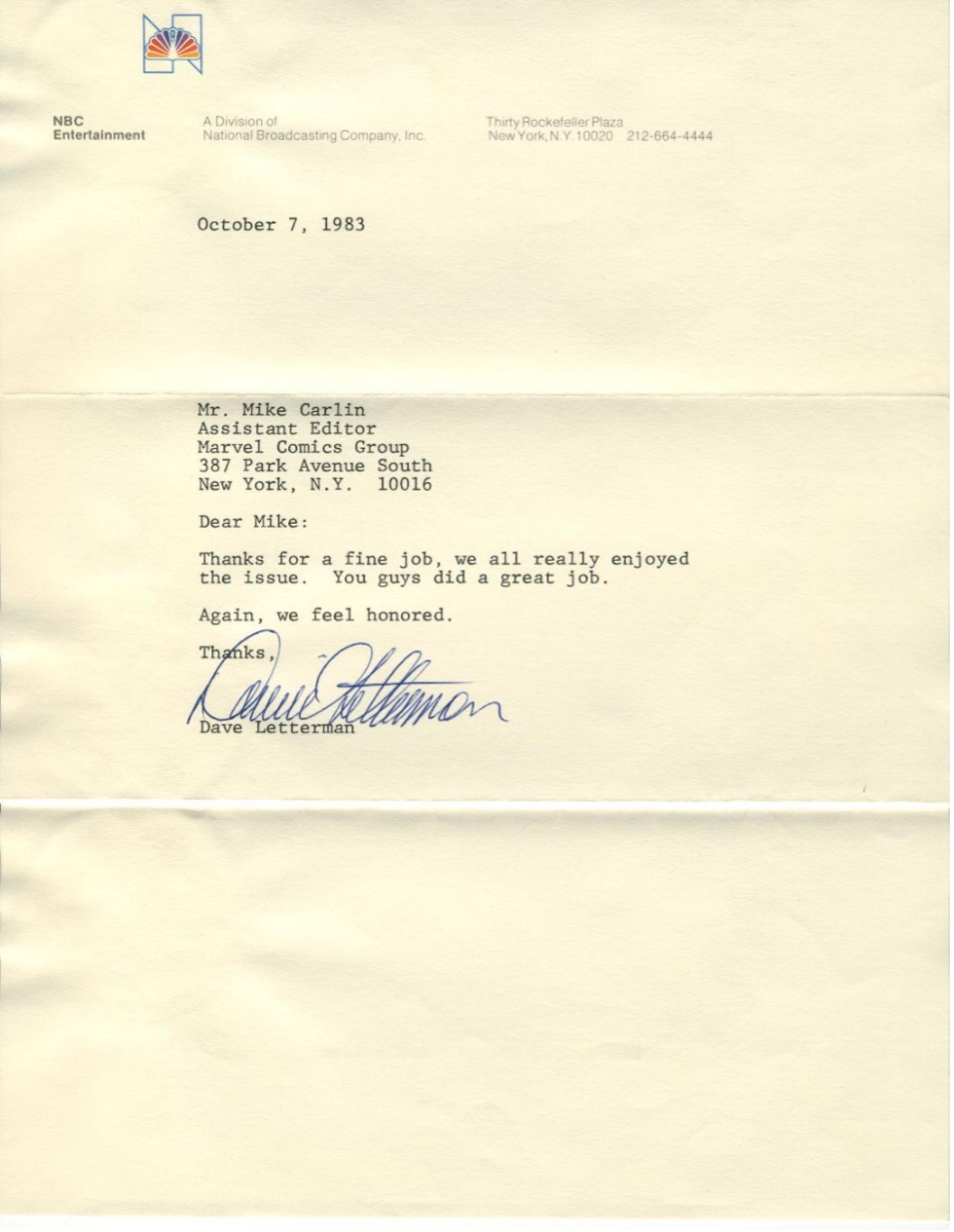
MC: As for Byrne, he simply thought it would be funny to do blank pages under the guise of a snowstorm. He was never ever late or running behind on any projects that I know of.
TW: I apologise. Returning to your inspired Galactus story if I may…
MC: I was asked to write the Marvel Team-Up issue for that month. Left to my own devices I tend to prefer infusing the work I do with more humorous stuff anyways. I did start my career at Crazy Magazine at Marvel, and last week I actually wrote my first piece for Mad Magazine. Career full circle!
So, I came up with the idea of using one of Marvel’s oldest characters alongside one of Marvel’s youngest characters in a story that was essentially a parody of the old Twinkie ads that used to run in both Marvel and DC Comics. Who would fit a story that was about eating better than Galactus? I couldn’t use Matter-Eater Lad for obvious reasons.
So Galactus always has a herald finding him planets to eat, and in a move that is the opposite of what the current Fantastic Four movie’s plot is, rather than Galactus making Franklin his herald I’d make Aunt May his herald. Simply because Golden Oldie is a funnier name than Shiny Tiny in the Silver Surfer mold.
It really was just an excuse to do a bunch of jokes and silly situations which could never have been done any other month at Marvel. Do you think the F4 movie makers got their idea for the recent movie from this issue? Nah! But… hmmm?
TW: How did you come to leave Marvel and eventually return as a DC Comics’ employee again? Was that all smooth sailing?
MC: I was an assistant editor for Marvel for 2 years, then I was promoted to full editor and worked with John Byrne on the Fantastic Four and Bill Mantlo and Steve Ditko on ROM and Archie Goodwin and Paul Chadwick on the Dazzler comics. This brings me to 1986 where I was not headhunted, and it was not smooth sailing because I was fired by Jim Shooter.
By this point, John Byrne was at DC working on Superman and Denny O’Neil had also left Marvel to work on Batman at DC.
I called up Denny O’Neil to let him know I was being let go by Marvel and he said “I don’t have any jobs right now, but I can buy you lunch” … I was introduced around at DC, and Dick Giordano said there was nothing at the time except a proofreader’s position. I had just gotten married, so I took their proofreading test and someone else got that job (thank Grodd!), but Dick said he liked the way I looked at things based on my notes.
At the same time the editor on Superman, Andy Helfer was starting up the Justice League franchise again, with Keith Giffen, Marc DeMatteis and Kevin Maguire so he’d be leaving Superman.
I’m sure DC asked Byrne who he’d like to work with as editor and he said that he and I got along when I was editing Fantastic Four, and I just happened to be freshly available! So that’s how I became the editor of Superman. Thanks to Marvel’s Editor-In-Chief.
TW: Before diving straight into discussing the Superman comics of the time, I understand you jumped ship (as it were) around 1986. This was when the first three Superman films had been released (with Superman IV: The Quest for Peace just around the corner?)
At that time, what were your thoughts about those first three films? Were you an enormous fan of them? Alternatively, back then could you find fault with them as a writer and an editor?
MC: Again, I didn’t so much jump ship so much as I was pushed overboard. My opinions of the movies are fairly standard in that I loved the first movie with a quibble here or there. I liked the second movie with some more quibbles, but it was still fun.
The third movie was all quibbles, as was Supergirl unfortunately, because Helen Slater was perfect then for the role. luckily for me I was the Superman editor when Quest For Peace came out so I got to go to the Premiere in Cleveland (birthplace of Superman). I was hobnobbing with Julius Schwartz, Noel Neill and Kirk Alyn so I was thrilled, less so with the movie.
TRIPWIRE NOTE: Noel Neill was an American actress that portrayed Lois Lane in the 1940s and 50s. Kirk Alyn the first actor to portray Superman.
TW: As you say you were less than happy with Quest For Peace. It is certainly not a universally loved film now. From your personal perspective at the time of release, was it slightly more warmly received? Nuclear disarmament was a hot topic issue at the time I believe.
MC: It wasn’t warmly received. It was a bad movie that got bad reviews, and it put an end to Superman movies for a while. Nothing wrong with the premise but the execution with a budget that wasn’t constantly being cut, oh, and competent filmmakers would have helped. The message wasn’t the problem. Weak special effects and actors sleepwalking through their jobs were.
TW: Looking back can you recall the very first Superman title that carried your name as editor? That sounds like it would be a memorable milestone in your career.
MC: That would have been Superman #4 (Vol. 2)
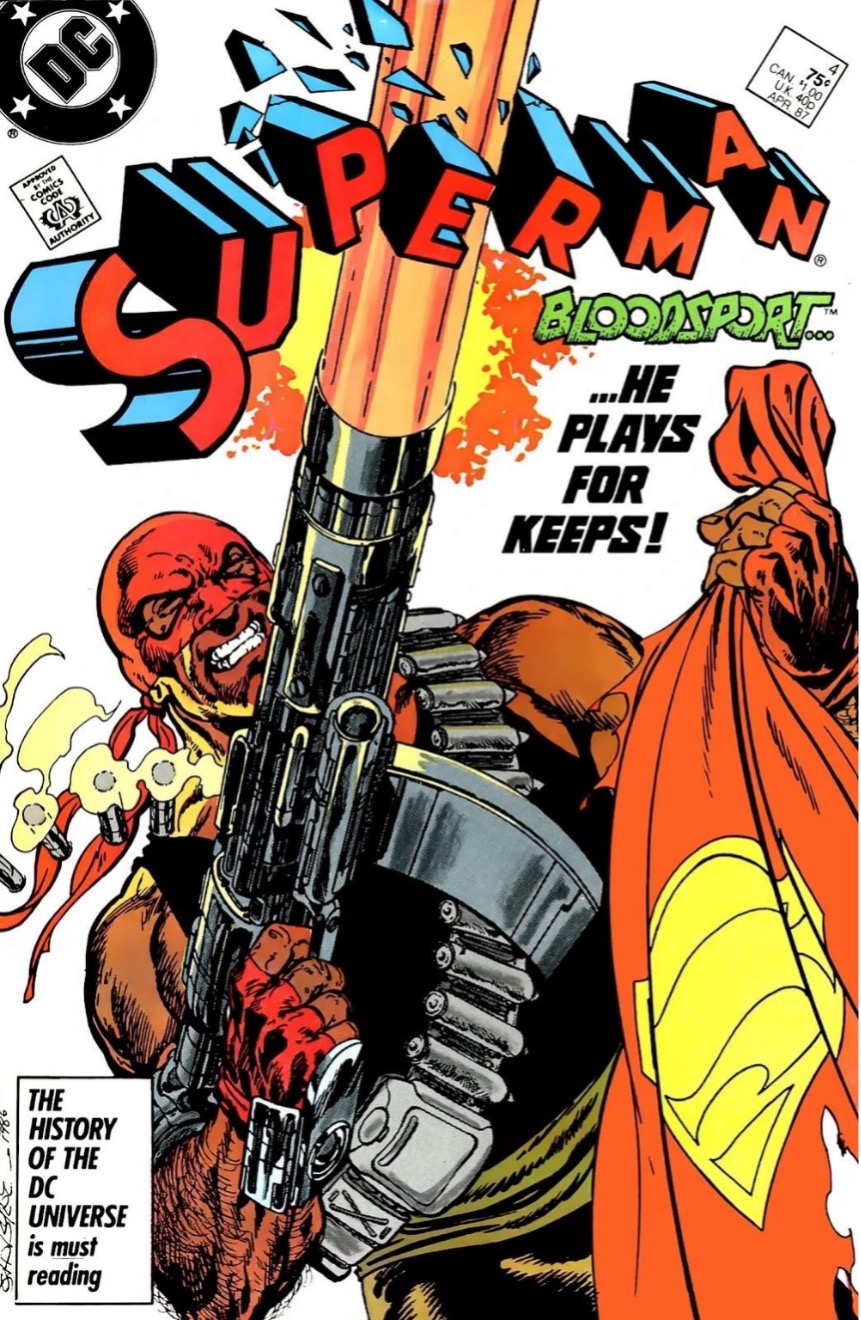
TW: Following up from the previous question, you took over as Group Editor of the Superman titles. At the time how many titles was that? Can you be specific about what you were responsible for putting together? I am guessing with annuals included, at the time that must have been rather a lot of comic books per year.
MC: For Superman alone it was 3 to 4 titles a month (as you point out with Annuals) then we added a 5th title: Superman: The Man of Tomorrow which was quarterly, so we essentially had 52 Superman titles a year.
But I also did The Shadow with Helfer and Bill Sienkiewicz and Kyle Baker, and Power Of Shazam! that started with Jerry Ordway’s graphic novel and went into a series by Ordway and Pete Kraus. There was also the adaptation of the Superboy TV Show. So, the actual number of books was always fluctuating but it was always more than just Superman (and in the capacity of group editor and later executive editor, I was overseeing a couple of editors’ work and then ultimately I was involved with all of DC’s DC Universe titles).
TW: You mentioned the Superboy comic based on the television series. Firstly, what did you think of the series? How do you personally compare it to the similar and longer running series like Lois and Clark? Can you pick a favourite at all?
MC: The series wasn’t the best but me, Jenette Kahn and Andy Helfer were DC’s liaisons on the series and with our input the show got incrementally better each season. The first season is very weak not because of the lead actor (who left after that season) but because of flimsy writing and premises. There were not enough super-level threats. Season 2 got better as more and more comic book writers were employed to write the scripts, including the new story editor hired, Cary Bates, a Superman comics veteran. The third and fourth seasons were the best by switching Superboy to working at a government agency that investigates supernatural events and characters, a premise that preceded The X-Files. The new story editor was Stan Berkowitz, who went on to work on the Superman animated series and Justice League shows in the 90s and 2000s.
Lois & Clark was more closely based on the comics we were doing at the time, with a bigger focus on the supporting cast at the Daily Planet, but after the pilot was filmed, DC had less and less to do with the show and personally I don’t think it’s as good as it could have been. Much bigger budgets (network television vs syndicated half-hour) make the show look a little better, but still, if the stories are weak none of it will be as great as it should be.
As far as picking a favourite I’m biased because I co-wrote 15 episodes of Superboy and, as mentioned above, it’s the only show that employed many major comic book writers (like Denny O’Neil, J.M. DeMatteis, myself and Helfer and Mr Cary Bates). I believe these writers understand the assignment better than folks who haven’t lived in the world of superheroes.
TW: The Superboy series ran between 1988 and 1992 for four seasons. The series frequently changed tone a lot with significant cast changes. It makes me wonder in general, as an editor did you face any significant extra challenges editing comics based on a television series or even movie adaptations? On titles like this, did you find there were a great deal of added requirements or requests from Warner Brothers or the relevant parties involved? Are such things a lot more work for an editor?
MC: There were no extra requirements on this comic adaptation for a couple of reasons.
1) I was involved in the show. 2) This wasn’t a licensed property. Superboy was DC’s IP so Warner Bros and Viacom (the producers of this particular syndicated version of S-BOY) weren’t involved. I was just able to do what I wanted.
Other licensed projects like The Shadow and toy tie ins like ThunderCats or Transformers I had worked on did involve showing material to the owners of the IP and we would need to respond to their notes. Most of the time that just meant adding a week or two to the schedule for them to make notes and for us to be able to address them. Not a lot of drama… hell, Conde Nast (the owners of the rights to The Shadow) even let us cut his head off! (!!!!)
TW: Before mentioning any HUGE crossovers or media events that I would like to come onto later, who introduced what is known as the Triangle Era in the Superman titles? Was the idea to number the reading order across the group to make things easier for readers or to encourage or boost sales on titles that may have been flagging somewhat? With the benefit of hindsight was it a success? Creatively were there any downsides?
MC: The Triangles were my idea, and it was purely selfish, so that I could find stuff easier as new material came in. I did think it would make things easier for readers to keep track (especially if they weren’t hitting their comics stores every single week) and I always hoped to make sure everything was being done to lift sales across the month. But Triangles or not, Superman (the flagship at that time) always sold a little better than the other three books, no matter which creative team was on the job.
TW: Can I ask before diving headlong into the subject, who was the very, very first person to suggest killing Superman?
MC: Jerry Siegel. He wrote the original version of this story in 1961. From Google: “The Death of Superman (1961) is a story authored by Jerry Siegel and Curt Swan in 1961 and published in Superman (1939) #149. “
Back in the day it was labelled as an “Imaginary Story”, but later it was retconned as an alternate reality and classified as Earth-149. It is the first “Death of Superman tale.”
For “our” Death of Superman, every single year we had a meeting (The Super Summit) the writers and artists (the Super-Team) would try to plan a years’ worth of adventures across the whole line of Superman titles.
Inevitably we’d hit a wall. We were just tired or needing a break, and Jerry Ordway would holler out “Let’s just Kill ‘Im!” We’d all laugh and go to lunch or dinner to recharge our creative batteries.
In 1991, we were planning the books for ’92 into ‘93 and we needed to get to Superman’s wedding to Lois Lane, a story we’d been setting up for a while. But Jenette Kahn and I knew that the Lois & Clark TV show was coming, so we wanted to hold off on the wedding for now (not cancel… just postpone). The idea being, if the show’s a hit, we could do the wedding a few years down the road at the same time in the comics and on TV— and if the show’s a bomb, we could do the wedding anytime we want to.
The team was bummed. They thought we had a firm plan and now to come up with something new that would equal the scale of Lois & Clark getting married after 55 years was a challenge. Well, let’s just say the ideas were not coming fast from the disgruntled room. Once again, Mr Ordway said, “Let’s just Kill ‘im!” and, feeling a little desperate, this time I said “Okay… IF we kill ‘I’m— what happens next?” and the room came alive planning the Funeral For A Friend arc… and the rest is available wherever comic books are sold.
TW: Issue 75 of Superman was released in November of 1992 and sold over six million copies and became a legitimate mainstream news story. Surely you anticipated a significant sales bump but were you surprised, or even astonished, quite how big a deal this single issue became and the media coverage it received?
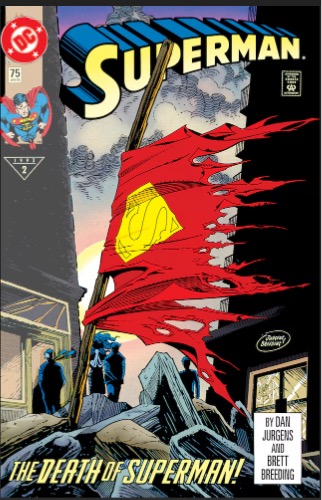
MC: We had no idea it would be as huge as it was. Heroes had died in comics before. The co-creator of Superman wrote a Death of Superman story in the early 60s. When we solicited the comic a newspaper on Long Island (Newsday) experiencing what must have been a very slow news day and put the Death of Superman solicitation on the cover of their paper. Then every other news outlet jumped on it.
When we saw the orders come in for the comic (which wasn’t printed yet), we panicked because we worried that comic shops would get stuck with them. So, no we didn’t expect any real bump for a story that, to us, was just the next adventure for Superman. Then we were astonished with how big it did get! That said, when the book was finally out, I knew I’d be talking about it for the rest of my life.
TW: In 1992 the internet was a far cry from what it has become nowadays. Reaction to comic events is practically instantaneous now, but I am guessing in the early nineties, fan reaction came from conventions and letters pages? Was the reaction to the storyline positive or if not how was it split? Did you receive a great deal of negative reaction?
MC: Reaction came from the media coverage first, and us artists, writers and editors did a lot of store appearances then, so we saw the reaction first-hand. The reaction was and remains generally positive with cynics seeing only something that they deemed HYPE. Well, we didn’t hype it, we simply solicited the next storyline. A big part of me is glad that we didn’t have the internet, not so much because I was afraid of negative reactions, but we would never have been able to pull off the surprises that came along in the Reign Of The Supermen follow-up story.
TW: Based on my research, Superman’s resurrection was always a part of your plans. Please correct me if I am mistaken. These days if Marvel or DC publish the story of the death of a flagship character, it is viewed with some understandable cynicism. Were you surprised, or perhaps pleased, that a reasonable number of fans thought Superman’s death would be permanent?
MC: I don’t think many “fans” thought Superman would stay dead. This story reached beyond the regular comic book readership, due to the media coverage and brought in a huge number of the general public. Some were hoping to be buying a valuable investment comic, while real fans knew there were so many copies being sold that any future value was probably a pipe dream.
Hopefully what regular fans got was a fun and ground-breaking new take on the “Death and Return” of a character. What DC got was obviously higher sales, but then several years of stories featuring a restored Man of Steel and two new characters, Superboy and Steel, who both went onto successful solo comics.
TW: As you mentioned, in the aftermath of the Death of Superman there were four versions of Superman that emerged to potentially take on the mantle of the Man Of Steel. As an editor and indeed a fan, did you have a particular favourite?
MC: I liked both Steel and Superboy for different reasons, which is why they were good additions to the Super-Family. They were, indeed, both very different from Superman. Steel embodied the core goodness and humanity of what Superman embodies, but without the science fiction powers and abilities while Superboy stood to need to learn about those values right before our eyes, and being half actual human DNA was why he struggled with those lessons more than Superman may have.
TW: The Death of Superman has been visualised in other mediums like Zack Snyder’s Batman versus Superman: Dawn Of Justice, and indeed a wonderful two-part animated effort. What was your involvement in both or either of those? Did you approve of them?
MC: I was involved in the Death Of Superman and Reign Of The Superman animated movies, and I approved of both of them, the Death Of Superman in particular as it is represented is a more direct adaption than anywhere else. I was particularly happy with the scene where Bibbo prays to God about losing his friend, pretty much because it’s word-for-word the scene that made me cry when I first read it in Roger Stern’s plot.
Let’s just say I didn’t approve of any other adaptations.
TW: 2016’s Batman v Superman: Dawn of Justice “made an effort” to adapt the Death of Superman and incorporated Doomsday. To your mind ,did you enjoy the film’s interpretation of Doomsday as a character, and the storyline? Did it work out how you might have hoped to see on the big screen? Surely you must have some thoughts.
MC: No comment, Paul.
I do have thoughts, of course, but I’ve answered the way I meant to.
TW: In the history of the comics industry, what would you say is the legacy of the Death of Superman as a comics event?
MC: That’s not for me to decide, that’s up to everyone else to figure out. I do think we did a standard trope in mythology and comics (the hero’s demise) and did something new and valid with it especially in the aftermath. The “Death” segment itself isn’t really a story, but the Funeral and the Reign chapters are where the meat of the story lies. That’s where we express what a Superman really means to the world.
TW: I have always been slightly fascinated by the Superman Red / Superman Blue storyline. It seemed to me there was an awful lot of untapped potential in the idea. How did it come about? I understand there was a Silver Age precedent to perhaps fall back on storywise, but in the modern era I recall it may not have been terribly warmly received. Is that true? Was there some initial negative fan reaction? Ron Frenz certainly did some stellar work on design work, I hope you would agree. I would argue it could have continued for longer as a storyline. It may sound stupid to ask, but I assume you gave the green light for the storylines involved.
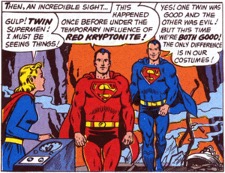
Tripwire Note: Superman-Red and Superman-Blue, Art by Curt Swan.
MC: Like many of our storylines, it started as a joke at our super-summit. This time it was an obvious suggestion from Glenn Whitmore, our colourist. As always, we also liked acknowledging things from the long history of Superman in comics, as well as other media, so we liked the idea of doing a modern/new take on the classic imaginary story from the 60s. We also liked the stories to be canon in our Triangle nooks. We didn’t do imaginary or Elseworld stories in the main titles, so the new take had to be part of our shared tapestry.
We always tried to do stories that we believed in as a group of creators, so “Superman Blue/Superman Red” is what it is. As you point out the story was not “warmly received”— in fact it was reviled and hated. Oh, well, we tried and did our best. As you also point out Ron Frenz, in particular, did some great design work for the actual look of Electric Blue Superman. As per usual, all the regular pencillers took a stab at designing the new look, and Ron’s was selected and embraced by us at DC.
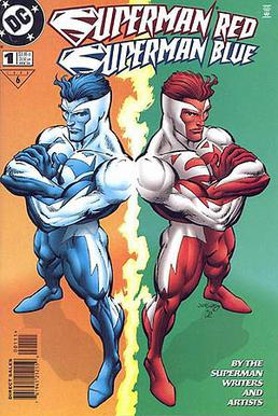
Tripwire Note: Cover of Superman Red/Superman Blue #1 (February 1998), art by Dan Jurgens.
That design came in handy down the road and worked extremely well when they introduced the Strange Visitor character later in the run. Here’s what I’ve noticed as 25-30 years have passed, a lot of younger readers now purport to love that story arc. So, predictably maybe, longtime fans maintain that they don’t want anything to change, and newer readers are up for adapting to fresh ideas, and then that becomes a beloved memory for them as they become 40-year-old fans.
Many, many fans have mentioned to me that they wished we’d have done an adaptation in the animated movies we were doing, and I would have loved that, but we only did 3 or 4 movies a year representing the whole DC Universe, while we had plenty of room to do many arcs in 52 Superman comics in a year. I never say never, they could still get to a version in the animated arena. Time will tell.
I wasn’t the direct editor on this series, but I was at the meeting where it came up in my capacity as VP-executive editor, and subsequently happily greenlit this adventure. What everyone needs to realize is that these were all just the next adventures in Superman’s life, and we always planned out the beginnings, middles and ends. So, nothing is permanent, they’re always just the latest in the series of Never-Ending battles in Superman’s life.
TW: As a fan I really enjoyed one of DC Comics lesser-known Superman crossovers. Specifically, that would be the “Millennium Giants” event. Obviously it was much smaller in scale than The Death of Superman or the stories that followed it, but I always felt it deserved greater recognition. It was a well organised and tightly written storyline that involved The Challengers of The Unknown characters that I had a soft spot for at the time. I believe you were involved in that storyline. Can you share any thoughts or memories of how it was all put together? What was the inspiration behind it? AND also, would you agree with me that it is actually a rather unappreciated classic crossover that doesn’t get the credit it richly deserves?
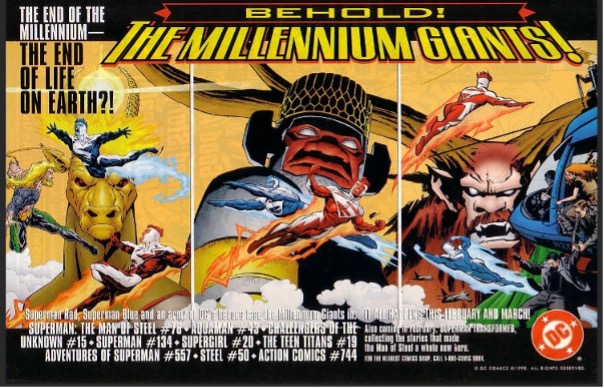
MC: Again, this was a story done when I was not the direct editor of the books, but I was part of the Super Summit with the two Editors who followed my run namely, KC Carlson and Joey Cavalieri. For this story, as well as “Superman Blue/Superman Red”, I was the VP-executive editor. I liked this adventure, as well and I remember it being spearheaded by Jon Bogdanove (with Louise Simonson) which was good, as it was probably their turn to instigate a big arc.
I’m happy you liked it, because everyone should know, as we knew, not every story was ever going to be “The Death & Return of Superman”. It was simply that 1999 was looming, the end of a millennia, and it was steeped in the lore of ley lines and such and they wove all these giant ideas with actual mythologically large Giants. And if the Challengers of the Unknown were involved you know that Karl Kesel was involved. He LOVED those guys!
TW: As we’ve chatted via email you said that your favourite project when you were VP-executive editor was the Marvel VS DC Crossover and the greatest idea ever concocted by 4 fanboys was the Amalgam Comics Universe, working with Peter David, Ron Marz and your old buddy Mark Gruenwald for one last time. Can you describe your involvement in the two projects? Was it a tricky balancing act giving equal billing to Marvel and DC Characters? Were there any particular Amalgam characters you thought were especially inspired?
MC: I was DC’s editor and ringleader. Mark Gruenwald was Marvel’s editor and ringleader. Not tricky at all. It was a one-to-one roster top to bottom, and we agreed to abide by the fan votes.
Even though Marvel won by one contest, DC conceded their win, but even Marvel acknowledged that it boiled down to a popularity contest. Nobody believed that in “real life’ Storm would beat Wonder Woman or that Wolverine would beat Lobo, but they were X-Men. They were members of the most popular team in comics during the 80s and 90s
You can see many of the proposed Amalgam characters as part of the extras in the Marvel Vs DC: Amalgam Omnibus published last year (2024) and my favourite Amalgam character is one we didn’t use: Alfred Jarvis: Giant-Size Manservant.
TW: I appreciate you eventually stepped down from editing the Superman group of comics and looked towards pastures greener and perhaps more animated? How did that come about? As the main Superman editor, a role you had occupied through some ups and downs (mostly ups as far as I can tell) WHAT was the last Superman comic you edited at that time? I hope it is not rude to ask but, was it hard to let go of such huge responsibility and pass it onto new editors?
MC: I couldn’t tell you which was my last issue as actual editor, mostly because I stayed on as VP-executive editor overseeing the whole DC Universe for several years, and I think the subsequent editors (Carlson & Cavalieri, as mentioned earlier) always knew that I had tricks and ideas to help them navigate the tough parts about linking 4 titles a month and that Superman would always be a favourite son of mine. That said, after the summits, I tried to stay out of the new editors’ way, unless they asked for help, but I was at least there for the big picture, and I was happy with where things were going.
So, I was direct editor for about 10 years, then I was VP-executive editor for about 7 years when I stepped down and went back to editing my own titles. I did that for about 8 years working on the JLA titles, Batman Confidential and events like Identity Crisis and several of the weekly titles like Countdown and Trinity. (Cursed to always do weekly comics! That’s probably a reason they were keeping an old editor around.)
Then management shifted and DC was planning a move to Burbank, California, but not the whole company at that point. Editorial was staying in New York City (along with MAD Magazine). That’s when I got the call from new CCO, Geoff Johns, who asked me if, even if editorial wasn’t moving to Los Angeles, would I be interested in moving to California to work on TV and animation with him?
I have always hated the cold weather and saw an opportunity to escape snow forever. I accepted his offer instantaneously, and I ended up as DC’s creative director for animation working as DC’s liaison with Warner Brothers Animation. Which was great, as they loved our work as much as we did, evidenced by the phenomenal series they’d already done on Batman: The Animated Series, Justice League Unlimited and Batman Beyond, among others.
I was still working with my friends, and DC’s characters, while Warner Brothers worried about hirings, deadlines and all the hassle stuff, I worked on stories and helping make suggestions for other characters to use or scenarios to use from DC’s vast history.
We did 3 to 5 features a year and several series including Harley Quinn and Teen Titans Go!, as well as some amazing DC Nation shorts spotlighting a lot of DC’s side characters like Deadman and Shade The Changing Man. These underrated shorts can probably be found on YouTube. I did that from 2011 to 2023, when I retired from DC leaving all the fun to the younger people.
I left DC after 37 years and cannot recommend retirement enough.
TW: What did you make of 2025’s Superman movie?
MC: I liked the new Superman a lot, with a few quibbles (wish he wasn’t beaten down so much and himself rescued so much)… but I was happy that Pa Kent was restored to offering inspirational humanity.
TW: Do you have any particular pieces of Superman merchandise that you are especially fond of or that you keep on display in your home? After all, there are action figures, t-shirts, lunchboxes, posters, Pez dispensers and many others too numerous to list. Indeed, for that matter, given your career were you often consulted on the design on a great deal of these sort of Superman items?
MC: Sometimes I’d be involved in the creation of material, but most would go through Warner Bros Consumer Products. I was involved in the first Superman statue done by Randy Bowen (and seen prominently on Seinfeld) so I have one of those out. My mother bought me a Superman logo blanket, which I could’ve probably gotten for free, but since she gave it to me, I love it and it’s out on a chair in my home office.
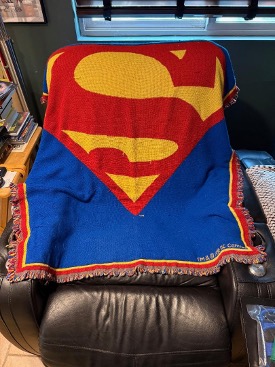
I have some one-of-a-kind art on my wall given to me by the artists on Superman (a cover by Mike Mignola, Superman #50’s cover by Jerry Ordway, the painted cover to Newstime Magazine which covered the Death by Denis Rodier, and even the MAD Fold-In by Al Jaffe that mocked Superman’s new Electric Blue suit, but that’s not stuff available to the public at large, There is so much Superman stuff that I couldn’t possibly keep every PEZ™ Dispenser that hits the shelves, but what I have I like.
TW: Were comic conventions a huge part of your career as an editor? If so, did you have any favourite conventions to attend? Would you have perhaps an amusing convention story or anecdote you could share?
MC: Yup, conventions were a big part of the job: finding new talent, meeting up with folks who you were already working with, and of course meeting readers and hearing feedback in person. I loved doing San Diego Comic Con when it was big, but waaaay smaller than it is today, and I always loved going to British conventions in London and Bristol, because in the pre-internet days I could wander the city and find music and books we didn’t have in the States.
Amusing stories? Tons of ‘em, I guess, but weirdest might be, the dinner about ten of us pros went to at an Italian restaurant in San Diego, where the waiters would get up and perform while customers dined. This year the owner came over to our table and said to us, “We hear that you’re with the Comic Convention, and we were wondering, hoping that you could get up and perform some of your comedy?” Rather than set the woman straight, David Wohl and I improvised a ventriloquist routine. We were the opposite of funny, but we had instructed our table to laugh uproariously no matter what we did. The restaurant still made us pay for dinner.
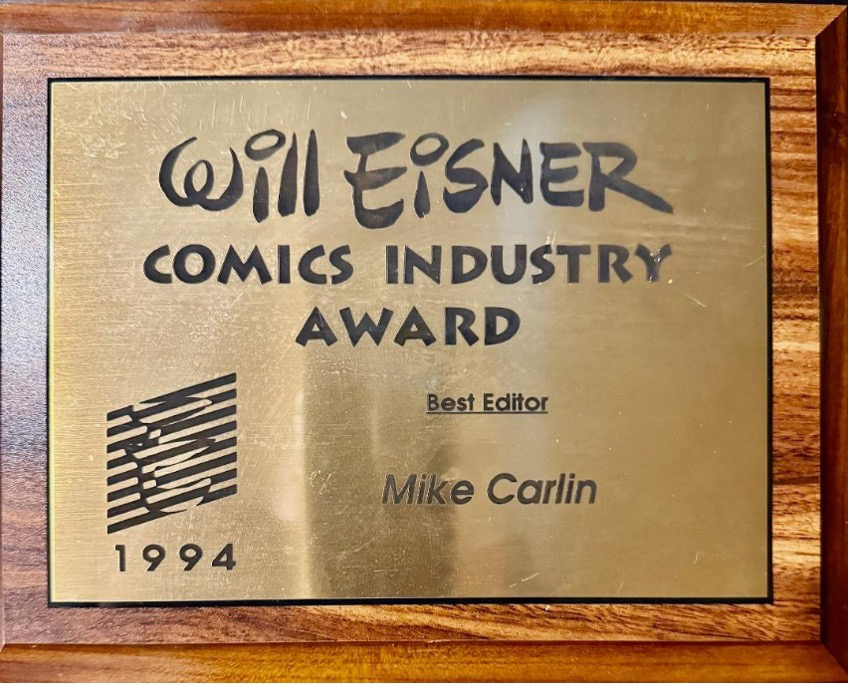
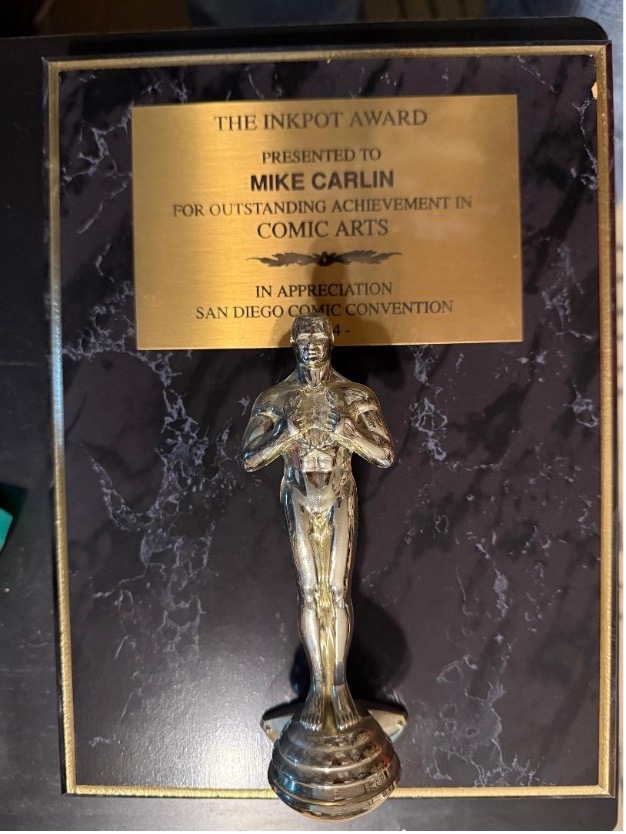
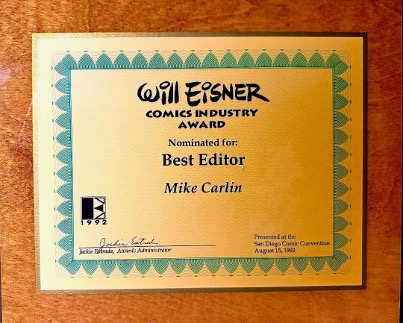
TW: What do your awards such as your Will Eisner and Inkpot award mean to you? Surely they much be treasured items for a career in comics, are they not? That sort of recognition must feel priceless.
MC: Inkpot means a lot to have been recognised for my work in my chosen field. Also since Eisner was my teacher at the School of Visual Arts where he actually hired us students to write jokes for some joke books he was putting together for Scholastic. He paid $1 a joke and I made $300.
When Will handed me the award, I told him my rate was now $2 a joke.
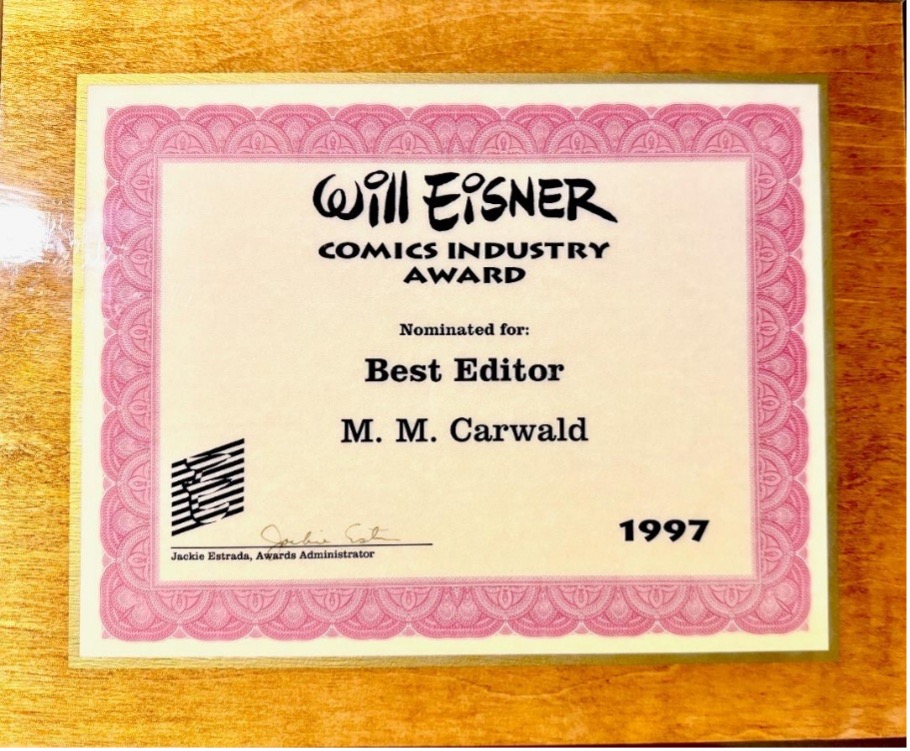
Being nominated with my pal Mark Gruenwald, as M.M. Carwald, for the Marvel vs DC/Amalgam project was the icing.
Sadly, they don’t give Eisners to editors anymore. They should. Editors can do great work.
TW: Do you still read a great deal of comics? Do you keep up to date with Superman’s latest adventures on a regular basis? Do you ever read comics digitally on perhaps an iPad or a laptop? or do you prefer a physical paper comic in your hands?
MC: I do not read a great deal of comics these days… my assignment for myself in retirement is to read the hundreds of prose books I bought over the 40 years I didn’t have time to read them. I have read a handful of current Superman comics and I’m happy to say, after many years of not being my personal cup o’ kryptonite, they’re currently back on a path I like. mostly because they’ve gone back to using Metropolis and it’s denizens more frequently.
Long before I left staff at DC, they stopped giving physical copies as comps, sending us DC’s output on Comixology. I thought I wouldn’t like reading comics on my iPad, but I loved it. These days the only comics related stuff I buy are the Artist’s Editions that Scott Dunbier pioneered, which reproduce original art full-size. Love ‘em!
TW: The final question. Can you say what Superman has meant to you personally over a career in comics? Is it even possible to say what Superman, and indeed Clark Kent, Lois Lane, Metropolis and Lex Luther and so forth have meant to you over the years?
MC: Yes it’s impossible to sum up, but Superman was always there in my life. My mother was a comic fan and totally supported my interest in them, and she loved Superman and Wonder Woman. So, comics, and Superman in particular was in my DNA. I’ve been very fortunate to be near Superman since high school. I got to be an intern at DC when I went to the High School of Art & Design, and I sat outside Julius “Julie” Schwartz’s office where I could hear him plotting stories with Cary Bates and Elliot S Maggin.
When I got the chance to guide Superman’s Never-Ending Battle as his editor I was very keen not to let my hero down. I was aware of his whole history, in comics and other media, and I wanted us to be reverential, but unafraid to fly forward.
Hopefully we, or I, didn’t drop the superball when it was thrown to us.







You must be logged in to post a comment.