

Comics News
Lenny Henry’s Favourite Graphic Novels

From The Sandman To Black Panther
♦ During the recording of the BBC’s Anansi Boys radio adaptation, Lenny Henry picked his favourite graphic novels and so here’s his choices courtesy of the BBC…
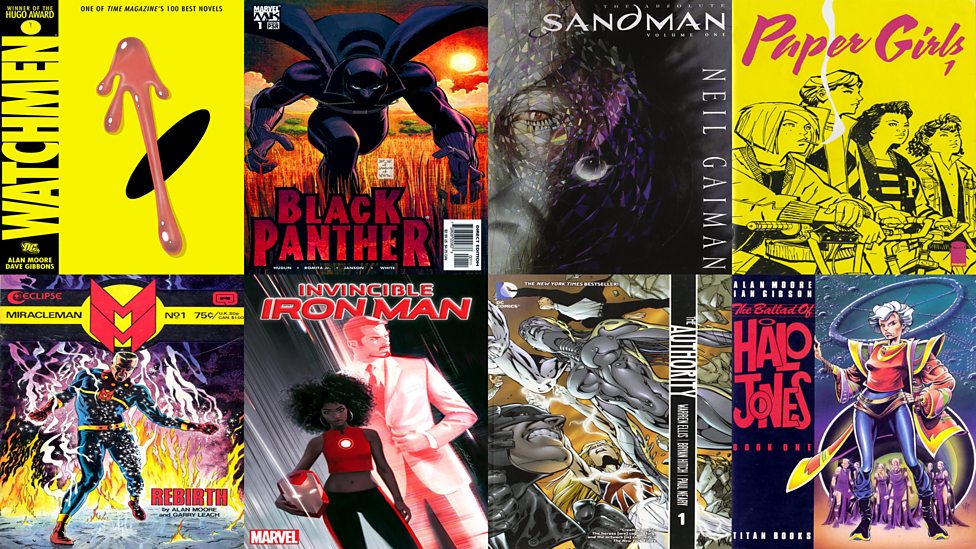
Sandman – Neil Gaiman
“Neil was writing out of his skin on Sandman”
– Lenny Henry on Sandman
Morpheus – or Dream – is one of the Endless, a family of brothers and sisters who have existed since the dawn of time and whose names all begin with D. There’s Destiny, Death, Desire, Despair, Delirium (who was Delight before she lost her mind) and Destruction. Initial plotlines focus on Morpheus reclaiming his lost kingdom.
Running for 75 issues, Sandman was awarded numerous awards and became Gaiman’s break-out title.
Gaiman returned to the series in 2013, writing Sandman: Overture, a six-issue mini-series which dealt with the events leading up to Morpheus’s capture at the beginning of the original series.
Black Panther – Reginald Hudlin
“His writing is brilliant and charming and funny and he made the Black Panther hip.”
– Lenny Henry on Reginald Hudlin
Reginald Hudlin grew up reading comics from lots of different companies, but felt an affinity and protectiveness over black characters like Luke Cage and Black Panther. While working on a film with storyboard artist Paul Power, the two of them starting to discuss comics. Power is friends with many artists and writers within the comic book community and would get them talking on the phone to Hudlin. Through this networking, he eventually met Marvel Editor Joe Quesada who convinced Hudlin to write the monthly series of Black Panther.
Hudlin changed many of the existing elements of the Black Panther. While Wakanda – the fictional African country where Black Panther is king – is a technologically advanced nation which has undergone rapid development, in Hudlin’s re-imagining, Wakanda had always been a utopia with futuristic technologies.
Watchmen – Alan Moore
The only graphic novel to reach the TIME magazine top 100 novels of all time, Watchmen profoundly changed the world of superhero comics.
Paper Girls – Brian K. Vaughan
Beginning in the early hours of Halloween in 1988, Paper Girls follows four 12-year-old girls who set off on their paper round. The girls – Erin, Mac, Tiffany and KJ – team up to protect themselves from the “many crazies” in the early morning, but on this particular morning strange forces appear, resulting in a time-bending tale that skips from 1988 to 2016 and beyond.
Vaughan wanted to write a comic which moved away from the stereotype of having female characters defined by their relationship to boys, particularly in a romantic way. The series focuses on the relationship between the four female protagonists and how they deal with the surreal events which happen to them.
The whole series has an overall tone of a mid-level budget monster movie such as the Goonies; the darker sensibilities create a more realistic approach to the era. This is the current favourite read not only of Lenny Henry, but also of Jacob Anderson.
Miracleman – Alan Moore/Neil Gaiman
Miracleman is a series mired in legal troubles. Starting out as a copy of Shazam in the 1950s called Marvelman, the character was revitalised in Warrior magazine with a darker re-imagining by Alan Moore in 1982.
Marvel Comics didn’t like the character sharing the same name as their character and it was changed in 1985 to Miracleman. Warrior magazine went under, but it was picked up by Eclipse Comics.
Miracleman follows Michael Moran, a freelance reporter who becomes Miracleman when he says the word “Kimota”, which is atomic spelled backwards with a “K”…
Brian Michael Bendis – Ultimate Comics: Spider-man, Invincible Iron Man and Powers
The impact that Brian Michael Bendis has had on the industry is undeniable. He won his first award for his series Jinx and followed this up with Powers, which follows two cops who investigate crimes related to superheroes. After Powers won multiple awards, Bendis was invited to work for Marvel.
Bendis wrote Ultimate Spider-man, an incredibly popular re-telling of Spider-man’s origins and early years. As the Ultimate line of comics was set in their own universe, they could make decisions that you probably could not pull off in the main continuity. This is how Bendis was able to permanently kill Peter Parker (Spider-man) and introduce a new character as Spider-man, Miles Morales. Marvel were praised for introducing a mixed-race Spider-man and the character proved popular. When the Ultimate line was discontinued, Miles was folded into the mainstream continuity.
The concept of a younger replacement character was again by Bendis when he introduced Riri Williams. Riri is a 15-year-old African-American genius who is taken under the wing of Tony Stark (Iron Man). She fights crime as Ironheart.
In November 2017 Bendis announced he was leaving Marvel, moving over to DC Comics.
Halo Jones – Alan Moore
Designed to be the antithesis of the super-tough women of superhero comics, Halo Jones was a driven everywoman character who lives in the 51st Century. Moore wanted specifically to add a female character to 2000AD comic.
The first story arc centred entirely around Halo and her friend going shopping. However, when you live in a crime-riddled floating city, where regular, potentially fatal riots take place, such a simple task requires military planning and precision.
Created in 1986, Halo Jones was a trend-setter for future female comic characters. Three volumes were created, each one jumping forward through her life, the last of which dragged Halo into an intergalactic war.








You must be logged in to post a comment Login