

Film News
Darkest Hour Reviewed

Lack Of Shade
Tripwire’s senior editor ANDREW COLMAN takes a look at Joe Wright’s Winston Churchill drama Darkest Hour starring Gary Oldman and out from next Friday, 12 January, in UK cinemas…
Darkest Hour
Director: Joe Wright
Stars: Gary Oldman, Kristin Scott Thomas, Lily James, Ben Mendelsohn
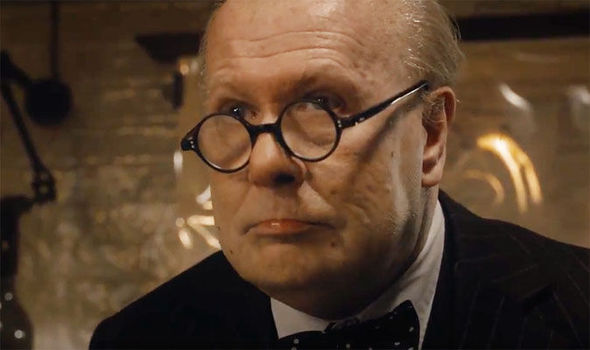
Joe Wright’s vignette biopic of Winston Churchill’s rise to power in 1940 is a film aimed at the Oscars that far too frequently withdraws into genre. Filmed in suitably austere monochrome, the movie plays well enough but cannot unshackle itself from time-honoured tropes about Our Winnie, and lead actor Gary Oldman, unrecognizable underneath a cage of prosthetics, does little to deviate from that version of The Greatest Briton.
As straightforward and linear a narrative as one would find in a historical documentary, the movie’s authenticity both draws us into its ghost tour and also distances the viewer – at times the foreboding and terror of imminent war is palpable, especially in the dank, claustrophobic Cabinet War Rooms, yet alternatively we are also in Madame Tussaud’s, gazing at spooky facsimiles uttering timeworn lines.
It’s May 1940, and Parliament is at a crossroads – the opposition Labour party are demanding the resignation of Prime Minister Neville Chamberlain (Ronald Pickup) due to his weakness in tackling the Nazi onslaught, while the British Expedition Force, outmanned and outgunned, are trapped at Dunkirk. Only Sir Anthony Eden (Samuel West) is on Churchill’s side, while Chamberlain and King George VI (Ben Mendelsohn) want foreign secretary, the reluctant Lord Halifax (Stephen Dillane) to be Prime Minister. The establishment and the conservatives distrust Churchill due to his maverick past and bellicose attitude, but have little option but to appoint him.
Indeed, nobody is on Winston’s side – the French consider him delusional and outmoded, while his so-called allies are dismayed by his belief that Hitler and his cronies are untrustworthy. The King finds him objectionable, and his mistimed first, rabble-rousing speech to the House goes down like a lead zeppelin. But Oldman’s turn remains jolly, philosophical and humorously rotund, marinated as he is in whisky, witty barbs and comedic potential. His gruff admonishments to his new secretary Elizabeth Layton (Lily James) quickly give way to a much warmer détente, all thanks to Clementine Churchill’s (Kristin Scott Thomas, pitch-perfect) guidance. In these domestic scenes he’s a bumbling teddy bear in a dressing gown, steered calmly by a stern martinet, puffing endless cigars and swigging brandies.
Eventually the tide turns in our hero’s direction – the King decides to back him rather than go into exile, while the House, including Chamberlain, is forced to concede after his valedictory “We shall fight them on the beaches” speech. This final sequence, preceded as it is by Winston’s first trip on the underground, showcases the film’s strengths and weaknesses – his chat with his fellow rail passengers is straight out of a propaganda reel, despite their heartening response (there’s even time for him to quip about his resemblance to a baby). Yet his declamatory triumph in the Commons, bristling as it is with supreme conviction, evinces the fear of the nightmare ahead – there were many darkest hours to come.
Many critics have hailed this film as a companion piece to Dunkirk, with Oldman a strong candidate for a gong at the forthcoming Academy Awards. But Dunkirk, for all its flaws, had ambition by the yard – this film, as well-made and cast as it is, often fails to escape cliché, the nuance required to transcend the narrative rarely visible. There are scenes when we are starkly in the moment, such as when Churchill and King George are apprehensively staring at the night sky from the palace balcony. This is primarily down to the mood of the setting but also due to Ben Mendelsohn’s subtle, measured performance – you feel his terror, but Oldman’s Churchill remains inflexible. His take is too good of an effort for it to be classed as a caricature, but with such heavy makeup, Oldman’s challenge to act through that immersive mask, coupled with the weight of history (whether it is true or otherwise) means that in the end, we only get the Churchill we’re familiar with.








You must be logged in to post a comment Login