

Headlines
Chris Roope Talks About The Look Of The BBC’s The English Drama Series

Creating The World Of The English
The English is a new Western drama co-produced by the BBC and Amazon and here’s its production designer Chris Roope talking about it…
How did you come to be part of this project?
I’ve worked with Hugo a number of times before: first on The Honourable Woman, and then on Black Earth Rising. I think we were three quarters of the way through Black Earth Rising when Hugo said we should do a period show together – three months later he said he wanted to do a Western. I read the first two scripts almost two years ago, so it’s been quite a journey. Of course, this was extended by Covid, but nonetheless, I was very excited from the outset.
When you first read the scripts, what interested you most from a production designer’s point of view?
What I enjoy about Hugo’s scripts is the setting of the particular story within pretty accurate historical frameworks. So, I think there’s always this reality as the base that you can always go back to for information and for grounding. With this being a Western, there’s a wonderful lineage and it’s a very beautiful story. So, I loved the idea of being able to put a bit of individuality into the various sets and locations. But also, a lot of people know Westerns and I want to be able to reference those but come up with something slightly different.
Can you tell us about your research process on The English?
Research for a Western is rather fun because it involves watching some films, looking at photographs, documents, reading some books, and looking at an awful lot of material online. Then there’s a very good book that Hugo recommended called The Cattle Kingdom, which outlines the backbone of the wider setting of the story. Then as a designer, you’re always looking at the specifics of the scene and what it has to give. You’re thinking where the action has to be and how does the character get from A to B?
What are the challenges associated with filming in incredibly remote and inaccessible locations?
Working in a hot country and in remote locations can be very challenging. You have to pace yourself, particularly over a shoot that covers about 4-5 months/17 weeks. You have to look after yourself and your crew, making sure that what you’re asking for is realistic. We’ve been fantastically fortunate with our crew and was endlessly impressed with their inventiveness, their ideas and their ability to keep going. The construction crew were based in the South of Spain, and they just kept going and bringing up new ideas and beautiful multimedia work, metal, textiles etc. It’s been a real joy.
What were the most exciting props to develop?
I’ve always had an interest in military history, so it was fun to think about the Gatling gun – we had to make sure it worked, but also reduce its size so it could be usable. So it’s always that interesting synthesis of not getting too bogged down with every last detail in order to realise the script.
How did the design of the High Street in Hoxem come about?
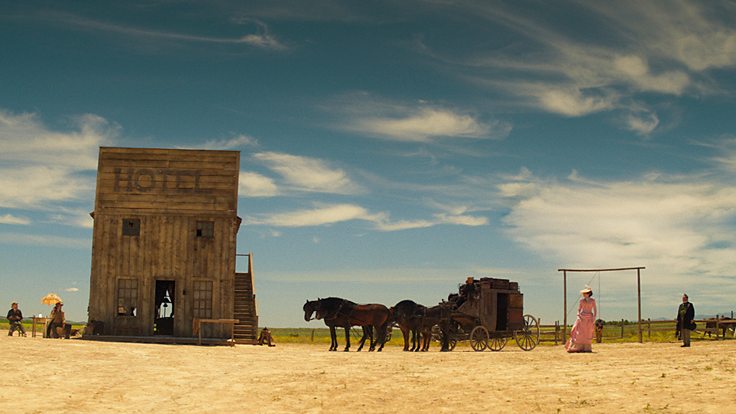
Hoxem as a town has been created by the character Melmont, who is putting his mark on the land, literally. The centre point of the town is the store of Melmont. The thing that interested me about the town is that it’s absolutely new. It’s been completely set up from nothing and he’s painted his name on the front of his store to say that he’s here to dominate. I did quite a lot of reading and writing, looking at pictures and discovered that a lot of towns basically started as tents. People came along and bought a plot and sat on the plot and would pitch a tent and keep their business running as much as possible. As that grew, they could afford to build wooden structures around them, so a lot of what happened is that they put a facade on things – literally and metaphorically.
Can you talk about the layout of the town?
We knew that the main action in the script took place in the Sherriff’s tent, Melmont’s stall and the carpenter’s shop. And so, the town is positioned to look straight down the valley, which is the view from Melmont’s stall. This is how we get the classic arrival shot of Eli and Cornelia on horseback. That’s a classic thing in the Western genre – seeing two riders coming on horseback with the sun behind them. So, the town faces – East – West and we had the buildings of the town on either side in an asymmetrical manner to give a dissonance to the layout.
Can you talk about the animals you worked with on the series and what that was like?
Doing a Western in Spain has a great advantage in that not only are the locations great, but the animals are too. We worked with a terrific horse master based in Almería called Hernán and his team of the most wonderful horse masters came with Western gear. They’ve done a few Westerns before, so they know the appropriate action, and they have access to and have worked with vehicle proprietors before. Therefore, we were able to source the correct wagons and stagecoaches. Horses are a massive undertaking on any show, but in additional to that, we had an animal wrangler who worked with the other livestock like cattle, wolves. In particular, what was wonderful was getting a herd of cows and cattle which were absolutely appropriate to the cattle that was around in the last third of the 19th century, which was a breed of the Texas Longhorn.









You must be logged in to post a comment Login