

Headlines
Ben Wheatley’s Free Fire Reviewed

All Fired Up Over Nothing
♦ Tripwire Contributing Writer JAMES DC reviews Ben Wheatley’s Free Fire, out now on Blu Ray and DVD…
Free Fire
Director: Ben Wheatley
Stars: Brie Larson, Armie Hammer, Sam Riley, Cillian Murphy, Michael Smiley, Sharlto Copley
Out now on DVD/Blu-ray
Stars: Brie Larson, Armie Hammer, Sam Riley, Cillian Murphy, Michael Smiley, Sharlto Copley
Out now on DVD/Blu-ray
As seems de rigueur at the moment, Free Fire, the latest offering from Ben Wheatley, has been hyped to the rafters by all and sundry, hence when I eventually saw it recently I had to push such hysteria to the back of my mind, in order to appraise it as objectively and as fairly as possible. Afterwards, however, I felt as disappointed as I had been with Wheatley’s previous, also vastly over-rated film in 2015, the silly, fudged adaptation of J.G. Ballard’s seminal dystopian novel, High-Rise. Yes, yes…I hear you…I know that Wheatley has made some brilliant, distinctive films, here and there; Sightseers (2012) is a nihilistic laugh-riot and A Field in England (2013) is some kind of hallucinatory pagan-horror masterpiece. But the critics’ contention that he is the unassailable genius of 21st century British cinema is premature and foolhardy, and this latest superficial, rolled out effort is further proof that either the quality control of his films is highly inconsistent or he is on a creative downward slope, as his films become more commercially viable and ‘hip’, thus causing him to lose sight of his original artistic perspective.
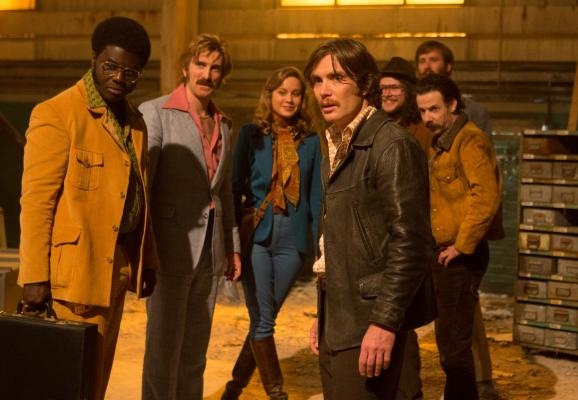
The very slim story goes thus: it’s the late 1970s and a couple of IRA members, Chris (Cillian Murphy) and Frank (Michael Smiley), are in Boston to buy a cache of assault rifles, machine guns and other armaments from a bunch of American criminals. They liaise with a number of underworld movers and shakers and the gun-runner himself, Vernon (Sharlto Copley). All are men, apart from one female intermediary, Justine (Brie Larson). After decamping to a deserted warehouse to seal the deal, an argument suddenly erupts between two members of the opposing sides and one fires a shot, causing some of the others to start firing, too. Everyone scatters instantly, taking shelter behind the detritus and old machinery of the ruined factory. A few guys try to negotiate a truce, but the more volatile gang members keep firing off rounds until the scene becomes a veritable bullet-fest and everyone ends up fighting for their lives. Various loyalties and friendships are tested and a psychological power play of distrust, cruelty and one-upmanship results, as a random element of two hired assassins invade the melee, too. As the members of each group gradually succumb to multiple wounds – albeit whilst engaging in badinage and taunting the enemy, ‘over the barricades’, at opportune moments – we are left wondering who will manage to survive the massacre, as Chris and Justine vie for the endgame in order to escape, barely alive.
According to Wheatley (in the sparse ‘extras’ interview features on the DVD of Free Fire) he wanted, in part, to create a more pared down and gritty crime-thriller than the usual fare; set mostly in one place and with a limited amount of protagonists undergoing ‘real-time’ traumas, so as to portray a more involving and ‘realistic’ jeopardy story. At first, this novel premise sets the film on a promising track. However, the concept soon runs out of steam, rapidly becoming repetitive and, more damagingly, unbelievable – precisely what the director purportedly wanted to avoid. For one thing, the sight of people with bleeding, painful wounds dragging themselves around the floor for hours on end, whilst constantly hurling provocative insults at the enemy or incongruously joshing with one another, hardly seems ‘realistic’. Most of the dialogue, as well as much of the behaviour, comes across as highly unlikely within the supposedly realistic setting.
“At first, this novel premise sets the film on a promising track. However, the concept soon runs out of steam, rapidly becoming repetitive and, more damagingly, unbelievable – precisely what the director purportedly wanted to avoid.”
Ludicrously, in one scene, someone gets tickled until they laugh out loud. Really? Would you actually mess about like that when bullets are whizzing over your head and people are bleeding to death all around you? Another pathetic moment is when a victim asks “are you wearing perfume?” as another guy pummels him in the face. But, surely this is meant to be a ‘dark comedy’, and therefore such nonsensical farce is allowed? ‘Artistic merit’ and all that guff. Nope, that doesn’t wash either; there just isn’t enough variety or complexity within the paper-thin parameters of the set-up for any decent comedic situations to occur ‘naturally’ – it all feels too forced. Besides, most good comedy works within a grounding of realism, but the supposed humour here is at odds with the rest of the film. Consequently, the mood of the piece is caught between two competing impulses, with Wheatley seemingly undecided as to whether to go whole hog with a full-on, farcical pastiche of mainstream action movies, or whether to produce something more authentic, gruesome and meaningful (this exact same dichotomous problem also hampered High-Rise).
In terms of influences, it is apparent that Wheatley is attempting, in a pick ‘n’ mix way, to pay homage to a roster of gritty and muscular ’60s and ’70s crime epics by the likes of Martin Scorsese (one of Free Fire’s executive producers, in fact), Sidney Lumet, William Friedkin, Sam Peckinpah, and later Postmodern directors like John Woo and the aforementioned Tarantino. Plus the whole Blaxploitation genre and a hundred other ‘retro-hip’, hard-and-fast films of years gone by. But he ultimately fails to bring off such a feat, perhaps too slavishly in awe of such filmmakers, while not enough of a visionary to pull off something truly radical.
Free Fire would have been a much better film if both the director and his regular collaborator, screenwriter Amy Jump, had been less obsessed with equipping the scenario with countless ‘cool’, Tarantinoesque bon mots and nonchalant, rambling asides from the larger-than-life characters. Such annoying garrulousness eventually becomes redundant and meaningless; it is self-conscious and clichéd, bogging down the few trenchant witticisms and emotional nuance that might otherwise have slipped through the verbose garbage to make the viewer actually feel something. It’s almost as if the filmmakers came up with what they thought was a fascinating bare bones concept, but then realised they had to stretch out the premise for 90 minutes, with no plot to speak of, so simply filled in the time with a smorgasbord of inane banter and macho posturing – instead of sensibly going back to the drawing board and starting all over again.
It’s a shame, because I can see the germ of a thrilling, unique film here, a type of violent ‘chamber piece’, revolving around stuck rats in a trap, after a dodgy deal goes wrong. Instead of the preponderance of modish ’70s apparel, showy pyrotechnics and trendy cinematic references – as well as the obligatory ultra-hip, ironic soundtrack by the likes of John Denver and Creedence Clearwater Revival – this could have been, say, a brutal but droll absurdist drama, with echoes of Samuel Beckett. Rather, it feels like a misjudged attempt to make a cult-indie version of an episode of The Sweeney, albeit with lashings of ultra-violence, a surfeit of shallow and unlikable characters, and set in a deserted Boston warehouse instead of a run-down pub, in West Ham. So why exactly was Free Fire set in the 1970s? What relevance does that decade have on any of this? Surely the basic scenario could have just as easily been set in modern times? Well, as I say, like Tarantino and all other cine-geek directors, Wheatley loves to play around with the décor, clothes, outdated attitudes, ribald humour and cinematic tics of that far-flung decade – no problem there, per se, as long as he were to actually accomplish such a task. But the main reason is that if modern technology, like mobile phones, were part of the story, the film would be over within about 20 minutes; the protagonists would instantly call for help and the cavalry would rapidly arrive to blow the enemy away (Wheatley confesses to such a ruse in the ‘extras’ interview, but I had already instinctively figured it out, as I watched the film).
It’s a shame, because I can see the germ of a thrilling, unique film here, a type of violent ‘chamber piece’, revolving around stuck rats in a trap, after a dodgy deal goes wrong. Instead of the preponderance of modish ’70s apparel, showy pyrotechnics and trendy cinematic references – as well as the obligatory ultra-hip, ironic soundtrack by the likes of John Denver and Creedence Clearwater Revival – this could have been, say, a brutal but droll absurdist drama, with echoes of Samuel Beckett. Rather, it feels like a misjudged attempt to make a cult-indie version of an episode of The Sweeney, albeit with lashings of ultra-violence, a surfeit of shallow and unlikable characters, and set in a deserted Boston warehouse instead of a run-down pub, in West Ham. So why exactly was Free Fire set in the 1970s? What relevance does that decade have on any of this? Surely the basic scenario could have just as easily been set in modern times? Well, as I say, like Tarantino and all other cine-geek directors, Wheatley loves to play around with the décor, clothes, outdated attitudes, ribald humour and cinematic tics of that far-flung decade – no problem there, per se, as long as he were to actually accomplish such a task. But the main reason is that if modern technology, like mobile phones, were part of the story, the film would be over within about 20 minutes; the protagonists would instantly call for help and the cavalry would rapidly arrive to blow the enemy away (Wheatley confesses to such a ruse in the ‘extras’ interview, but I had already instinctively figured it out, as I watched the film).
On a fundamental level, the screenplay by Amy Jump just isn’t up to scratch and so doesn’t ground the film in any sense of reality; after a while it feels like you are simply watching a souped-up movie version of a computer game shoot-’em-up – where you couldn’t really give two hoots as to whether any of them survive or not – but with a ton of ‘knowing’, hip quips thrown in to try and differentiate it from the average commercial blockbuster. (Tellingly, in the DVD extras, Wheatley states that Jump came in and sporadically improvised a lot of the dialogue, on set, as they were filming. He was against this at first, but then realised she was ‘right’, and eventually gave in. Perhaps Jump’s inchoate, flippant attitude to the basic structure of the story, as well as Wheatley’s obeisance to her in such matters, is why his films are starting to seriously go astray. Unfortunately, for committed Ballardians everywhere, the flawed screenplay by Jump was the weakest aspect of High-Rise, too.) Basically, there is never enough time for a ‘breather’, nothing is ever subtle, and everything is in your face, until it all becomes self-defeating: without such rhythmic pacing to the narrative we soon lose interest. It’s a bit like watching, for hours on end, a gang of frenzied boys constantly play-fighting with toy guns in the playground – it may be fun for them, but mature adults will, of course, find it infantile, narrow-minded and dull.
Another major fault with the script is that we don’t end up caring about any of these A-holes; there are hardly any interesting or sympathetic characters, with the absence of a decent backstory for any of them compounding the problem. (One of the better characters, played by Brie Larson as the only woman in the ensemble, should have been more fleshed out, for a start.) Furthermore, there aren’t enough establishing shots near the start in order to let us settle in a bit, before all hell is let loose; thus the impact of the gun battle is diminished through lack of context. Of course, opponents of this viewpoint will say that Wheatley is simply going for a ‘jump in the deep end’, minimalistic structure, where it doesn’t necessarily matter that we don’t know anything about these people before the disaster strikes – they are suddenly put in danger, out of the blue, like any of us potentially could be, and that’s enough to carry the film. Sure, such a conceit has worked well in many films, over the years. However, most of those films gradually made us empathise, in some way, with the humans on screen. Wheatley’s film doesn’t bother with any of that. He thinks a barrage of meaningless, smart alec one-liners and a few grunts and moans while these psychos endlessly duck and hide from oncoming bullets will suffice to make us care. It doesn’t.
So then, what is left? Not much, really. There are a few nice, slightly balletic touches to the all-in-one, action set piece – although, having said that, I have seen more exciting and inventively choreographed ‘bullet fights’ in Hollywood B-Westerns from the 1940s! But, to make matters worse, as the violence, gunfire and multiple wounds ratchet up, everything becomes more hectic in terms of three-dimensional ‘spatial awareness’, i.e. many situations are hindered by an extremely confusing mise-en-scene. For a lot of the running time, you simply cannot make out who is shooting who; like a lot of modern filmmakers, Wheatley doesn’t seem to understand the basics of how to tell a story well in cinematic terms, instead opting for a ‘blipvert’ aesthetic and visual free-for-all, all the while hoping that no one will notice (and no, just because the gun battle is a tumult doesn’t mean that the film itself should be incomprehensible in those particular scenes, also).
One would have thought that, given Wheatley’s avowed intention to create a more authentic setting when it comes to ‘being shot at’ (he supposedly studied reams of ballistics and forensics reports to try and get the trauma experiences and survival tactics of firearms victims just right), he would at least have not resorted to the type of messy, frenetic editing and irritating camerawork of your common-or-garden summer blockbuster. If, like me, you rapidly get bored with such ‘ADHD’ visual antics, then you will rue having paid for such nonsense, masquerading as something more substantial; Wheatley should go back and re-watch, say, Friedkin’s The French Connection (1971), to see how a master film director uses simple, but highly effective, old skool cinematic techniques to emotionally involve the audience in gut-wrenching thrills and spills. (Hell, at least 80% of modern film directors should continually re-watch all the old classics, until the fundamental rules of great filmmaking are finally indented on their lame brains!)
Sure, I will concede that, despite the increasingly tiresome proceedings, there is the occasional funny crack or pratfall, plus a couple of mildly absorbing scenes where we – sort of – root for one of the dodgy guttersnipes trying to survive. And there is always the pleasure of watching riveting and endearing actors like Michael Smiley and Sharlto Copley. But then, because of this, one wishes that Wheatley and Jump had excised some of the blander, more disposable characters in order to concentrate on these more well-rounded, intriguing ones; ironically, given his intentions, Wheatley was not minimalistic enough, this time round.
In the final reckoning, this is a one-dimensional, uninspired and rather tedious folly, lacking any real depth or innovation. But let’s hope that Wheatley eventually gets his act together and recaptures some of the imagination and ingenuity he showed in his earlier work. You never know….
Free Fire is out now on Blu Ray and DVD










You must be logged in to post a comment Login